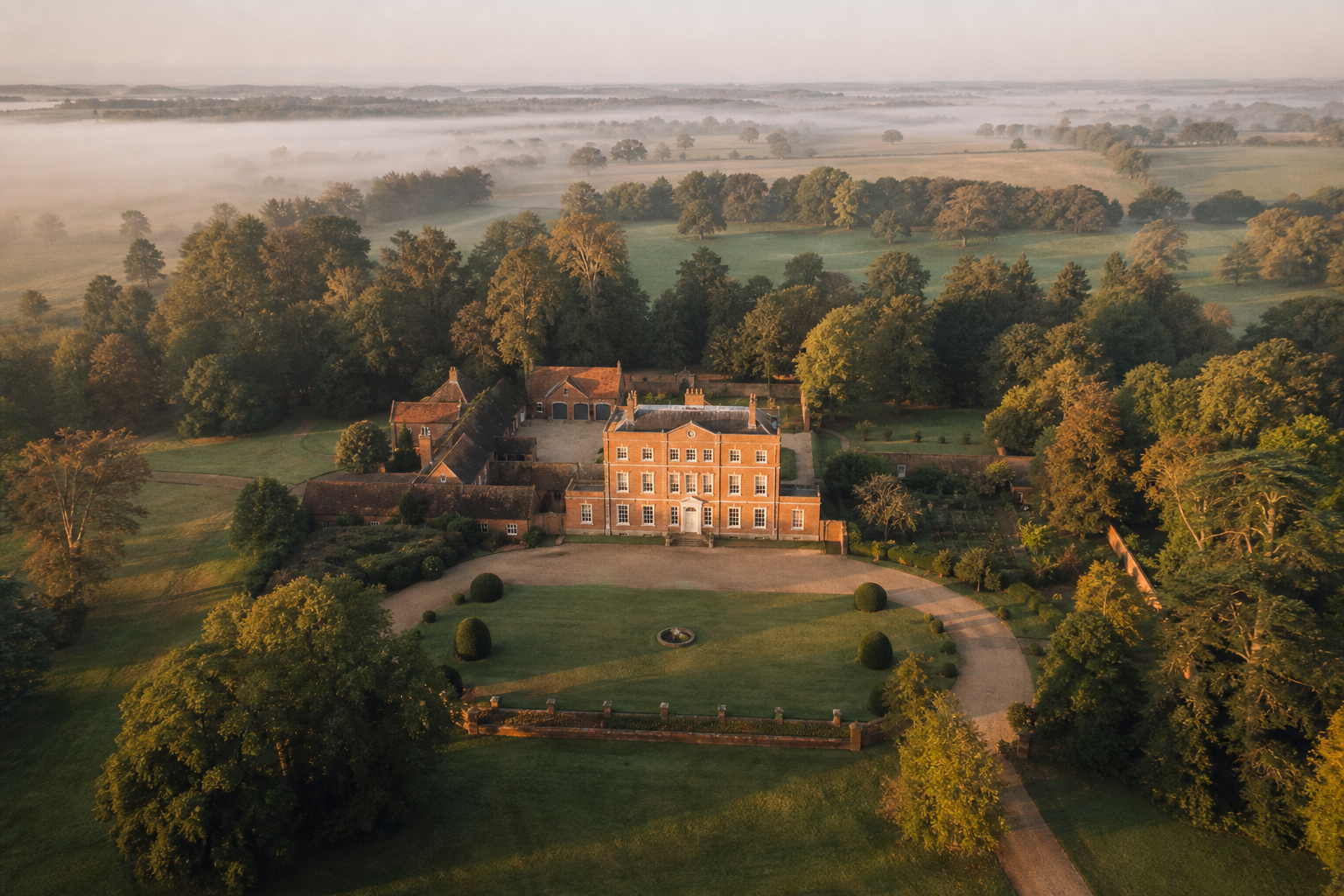
One million pounds. It is a significant figure in any property market. In Norfolk, it is also a surprisingly elastic one. Depending on where you are standing in the county, a budget of £1 million can unlock anything from a handsome detached family home on the edge of a market town to a substantial country house with land, outbuildings and views across an undisturbed river valley.
Understanding this geography is not just useful for buyers scoping out a move. For anyone thinking of selling a home in this price bracket, it matters enormously. The same money tells a very different story in South Norfolk, the Broadland villages, the North Norfolk coast or the rolling countryside of Breckland. Knowing where you fit within that picture is the beginning of a well-informed sale strategy.
Norfolk’s average house price sits at around £297,000, according to current Land Registry data. At first glance, that figure makes a seven-figure budget feel like significant headroom. But Norfolk is far from uniform. Prices range from under £120,000 in parts of Great Yarmouth to over £550,000 as an average in the most sought-after North Norfolk coastal postcodes. At the £1 million level, the variation between areas is dramatic.
Across Norfolk as a whole, properties above £1 million represent approximately 2% of the market. At any given moment, roughly 314 homes above that figure are listed for sale countywide. Each of those homes is competing in a market shaped by its own micro-geography, its access to the coast or city, its character, and its land. The question buyers and sellers alike should be asking is not simply “what is my home worth?” but “what does £1 million represent in this specific location?”
South Norfolk has quietly become the county’s most expensive district by average price. The ONS recorded an average house price of £311,000 in January 2026, with detached properties averaging £426,000. But it is at the upper end of the market where South Norfolk truly distinguishes itself.
For £1 million in South Norfolk, buyers can typically expect a substantial detached property, often a former farmhouse or converted barn, set within a village or rural location with land attached. Villages such as Hethersett, Saxlingham Nethergate, Stoke Holy Cross and Mulbarton have all produced sales at or above the million-pound mark, with properties offering five or more bedrooms, mature gardens and, in many cases, secondary accommodation or outbuildings.
South Norfolk has recorded the strongest ten-year price growth of any district in the county at 57%, according to Land Registry analysis. For sellers in this area, that long-term trajectory represents both real gains and a market that rewards well-presented, distinctive homes.
Broadland covers some of Norfolk’s most photographed countryside, including the rivers and waterways of the Broads, the quiet villages north and east of Norwich, and the established communities of Taverham, Cawston and Aylsham. It also recorded some of the strongest year-on-year price growth in the county in 2025, with figures running at 7.5% in certain postcode sectors, according to SAM Conveyancing’s Norfolk market analysis.
A million pounds in Broadland buys something rather specific. The most distinctive homes in this market are period farmhouses, substantial barns converted with precision, and riverside properties with private moorings or direct water access. In villages like Coltishall, Hoveton or Blofield Heath, a seven-figure home will typically offer six bedrooms, a significant garden, and a setting that cannot be replicated closer to the city.
The commuter logic is important here. Norwich is within twenty minutes of most Broadland villages, which has drawn buyers who work in the city but want the texture of rural Norfolk around them. That demand has kept well-presented family homes moving consistently, and Broadland holds the lowest crime rate of any Norfolk district, an important consideration for families in the market at this level.
The North Norfolk coast has been the county’s most discussed market in recent years, and for good reason. Burnham Market, Blakeney, Holt, Wells-next-the-Sea and Brancaster occupy a particular place in the British property imagination. Properties here carry a premium that goes beyond bricks and mortar. They carry a lifestyle.
A million pounds on the North Norfolk coast is, by local standards, a firmly mid-market budget. In Burnham Market, a village long associated with London buyers and second-home ownership, a detached flint cottage of three to four bedrooms in a good position may sit at exactly this price point. Move upward to a more generous plot, a sea view or a house of genuine architectural note, and the asking price rises considerably.
It is worth noting that the North Norfolk market has seen some softening from its post-pandemic highs. Average prices in North Norfolk fell 3.6% in the year to December 2025, according to ONS data, a contrast to the county-wide picture. Some sellers in prime coastal villages have adjusted their expectations as the pace of discretionary buying has moderated. The affordability ratio in North Norfolk stands at 10 times the median local salary, the highest in the county, reflecting the level of external wealth that has historically flowed into this market. For buyers, this represents one of the more interesting negotiating environments the North Norfolk coast has offered in some years.
Breckland sits at the heart of Norfolk, bordered by the ancient Breckland landscape, the market towns of Dereham, Swaffham and Thetford, and the quieter villages that stretch toward the Suffolk border. It is a part of the county that does not always feature in the headlines, but at the million-pound level it offers something compelling: genuinely large homes, significant land, and architectural character at prices that would be impossible to replicate in coastal or commuter locations.
Breckland’s ten-year price growth sits at 56%, matching South Norfolk’s trajectory and demonstrating a sustained upward movement in values across the district. The average detached home here sits well below the county’s upper end, which means that a million-pound budget commands a home at the very top of the local market. Buyers in this price bracket are typically looking at substantial farmhouses with multiple acres, or period properties with extensive outbuildings, often with the scope for personalisation that buyers at this level tend to seek.
For sellers of properties at this level in Breckland, the buyer profile is often specific. These homes attract a mix of equestrian purchasers, those relocating from more expensive markets seeking maximum space, and buyers drawn by the landscape’s distinctive character: the pines, the open skies and the undisturbed farmland that defines this part of the county.
Across all four areas, certain patterns emerge when examining what motivates buyers at this level. The primary drivers for million-pound purchases in Norfolk are lifestyle and location quality, rather than investment return alone. These buyers want a home they can inhabit fully: space for working from home, gardens of genuine size, settings that feel remote without being isolated, and properties that carry a quality of character that a new build simply cannot offer.
The affordability ratios across Norfolk’s districts tell an interesting story. North Norfolk’s ratio of 10 reflects deep external demand. Broadland at 7.9 and South Norfolk at 8.0 indicate strong local professional demand anchored by Norwich. Breckland at 8.1 reflects the premium placed on the most distinctive rural properties in that market. In each case, homes at the million-pound level are drawing buyers who are making a considered, often values-led decision about how and where they want to live.
For anyone selling at or near this price point, the practical implication is clear. Your buyer is unlikely to be purely local. They are almost certainly comparing your home against others in different parts of Norfolk, and potentially against options in Suffolk, Cambridgeshire or beyond. The presentation, the story and the marketing of your home need to speak to that wider audience.
Market data can tell you what £1 million typically buys in each area. What it cannot capture is the specific quality that makes one home sell within days while another sits on the market for months at a similar price.
At this level, buyers are making decisions that are partly rational and partly deeply personal. They are imagining morning light through a particular window, the sound of quiet in a walled garden, the specific way a reclaimed stone floor meets a kitchen of genuine quality. The homes that achieve strong results in the Norfolk million-pound market are invariably the ones where those details have been considered, captured and communicated.
Professional photography that understands light and scale. Drone footage that places the home in its landscape. Floorplans that give buyers a clear sense of how the space flows. A description that articulates the feeling of the home, not merely its features. These things are not optional at this price point. They are the difference between a home that attracts the right buyers quickly and one that quietly loses momentum.
Norfolk’s property market in 2026 is active across all areas. Current data shows approximately 18,647 properties listed for sale across the county, with the £500,000 to £1 million band containing around 2,391 listings and the over-£1 million segment sitting at 314. The market is not thin. But competition is real, and presentation matters more than it has in some years.
For sellers considering whether this is the right moment, the stronger argument is that well-presented homes in compelling locations continue to attract committed buyers. Savills has projected 18.5% price growth across the East of England over the five years to 2029. For homeowners who have seen values appreciate significantly over the past decade, the question is not whether to sell eventually. It is whether to wait, and what that wait costs in terms of opportunity.
Every home in the million-pound bracket in Norfolk occupies a specific position in the market. Some will outperform comparable properties because of their setting or their story. Others will underperform because the marketing has not matched the quality of the home itself.
At The Ivybridge Collection, we work exclusively with distinctive homes across Norfolk and Suffolk. Before we advise on pricing or presentation, we take the time to understand exactly where your home sits within its own micro-market. That analysis informs everything: from the photography brief to the buyer shortlist to the negotiation strategy when the right offer arrives.
If you are considering a sale and would like an honest, research-led assessment of what your home is worth in today’s market, we would be glad to speak with you. The conversation costs nothing, and it may answer questions you have been quietly sitting with for some time.
You may also find Norfolk’s most sought-after villages helpful as you explore your options.
For the latest updates on the Norfolk property market, including mortgage rate changes, government policy, and local trends, visit our Norfolk Property Market News section.