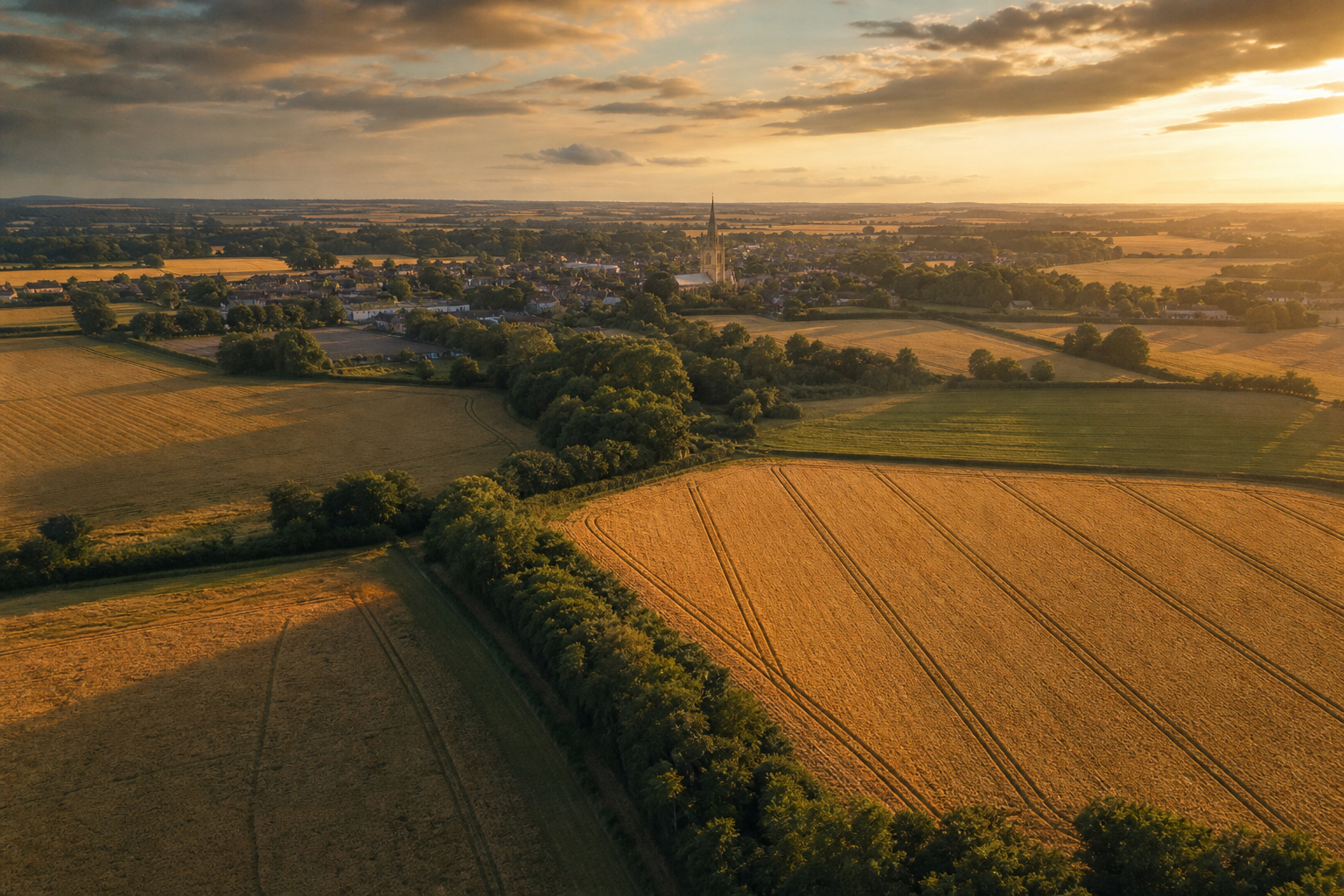
South Norfolk is one of the county’s most quietly compelling property markets. It lacks the coastal premiums of North Norfolk and the headline noise of Norwich city, but for buyers and sellers who understand what they are looking for, it offers something rarer: genuine character, strong connectivity and a quality of life that is difficult to replicate elsewhere in the region.
The district stretches from the southern fringes of Norwich down to the Suffolk border, taking in historic market towns, peaceful river valleys and an extraordinary collection of villages that have changed little in decades. If you own a home here, or are considering your next move within South Norfolk, this guide sets out what the market looks like in 2026, which areas are drawing the most interest and what the data tells us about value.
According to the Office for National Statistics, the average house price in South Norfolk reached £311,000 in January 2026, up 1.2% on January 2025. That places the district comfortably above the Norfolk county average and 16% above the UK national average of £268,000.
Breaking the figures down by property type reveals a more nuanced picture. Detached homes, which account for around half of all sales in the district, average £426,000. Semi-detached properties sit at £275,000, terraced homes at £230,000 and the limited flat stock at around £135,000. For buyers seeking a detached family home with space, South Norfolk consistently delivers more for the money than either North Norfolk’s coastal strip or the premium suburbs immediately surrounding Norwich.
Home-movers, rather than first-time buyers, dominate the South Norfolk market at the top of the price range. The average paid by movers in January 2026 was £353,000, reflecting the prevalence of equity-rich households making considered, lifestyle-led decisions rather than reactive purchases driven by mortgage affordability alone.
Wymondham sits at the heart of South Norfolk property activity. With its magnificent Norman abbey, medieval market cross and direct rail connection to Norwich in under 15 minutes, the town draws a consistent stream of relocators, downsizers and London escapees seeking accessible countryside without sacrificing amenity.
Current data from GetAgent places the average asking price in Wymondham at £318,182, with detached homes achieving around £328,000 to £380,000 depending on specification and position. Five-bedroom homes in the town average £651,250, a figure that reflects the presence of larger Victorian and Edwardian properties in its more established streets as well as quality new-build development on the southern and eastern edges of town.
Properties in Wymondham spend an average of 13 weeks on the market before going under offer, which is competitive for a Norfolk market town. The combination of train access, outstanding schooling including Wymondham College and Wymondham High Academy, and a well-served town centre continues to sustain demand across price points.
Diss occupies a distinctive position at the very southern tip of South Norfolk, straddling the county boundary with Suffolk and serving a wide rural catchment on both sides of the border. The town is centred on The Mere, a rare six-acre natural lake that forms the centrepiece of a conservation area and gives Diss an identity unlike any other Norfolk market town.
Average asking prices in Diss currently sit at £308,722, according to GetAgent data updated in June 2026. Detached homes average £381,143, while four-bedroom properties across the town achieve an average of £467,551. Five-bedroom homes in the wider Diss area average £771,842, a figure driven in part by the substantial farmhouses and converted barns that populate the surrounding parishes.
Diss also benefits from a mainline rail connection to London Liverpool Street, with journey times of around 90 minutes. For buyers seeking a genuine rural lifestyle without sacrificing access to the capital, this is a significant draw. The town’s regular markets, independent retailers and strong arts community reinforce its appeal to buyers who want culture and convenience alongside countryside.
Between Wymondham and Diss, and spreading east toward the Waveney Valley, South Norfolk contains a remarkable density of villages that command genuine premiums over surrounding urban areas. Mulbarton, Hethersett, Poringland, Framingham Earl and Long Stratton each offer their own combination of primary schooling, local amenities and easy Norwich access, making them perennial favourites with family buyers upsizing from the city.
Further south, villages such as Pulham Market, Pulham St Mary, Tivetshall St Margaret and Winfarthing sit within a quieter, more agricultural landscape where the property mix shifts toward farmhouses, converted barns and period cottages. Sold price data from Land Registry shows transactions in this belt regularly reaching £400,000 to £700,000 for the most distinctive homes, with significant outliers for exceptional rural properties.
The Forncett area, close to Long Stratton, produced a notable sale in March 2026 when a converted barn property achieved £690,000. Transactions of this type illustrate a consistent dynamic in South Norfolk: buyers at the £500,000 to £900,000 level are actively seeking homes that combine rural character with viable connectivity, and they are finding it here.
Harleston is one of those South Norfolk towns that rewards those willing to look beyond the obvious. Set on the River Waveney at the Suffolk border, the town has a Georgian high street of genuine quality, an active independent retail scene and a community feel that larger towns struggle to replicate. Property values remain more accessible than Wymondham or Diss, which makes Harleston increasingly attractive to buyers priced out of those markets.
The wider Waveney Valley corridor, running through Bungay, Beccles and out toward the coast, is becoming one of the more talked-about relocation destinations in the region. As remote working becomes entrenched rather than exceptional, the calculus for buyers has shifted: proximity to a motorway matters less than quality of environment, and South Norfolk’s river valleys score highly on that measure.
The South Norfolk market in mid-2026 is characterised by motivated buyers and a realistic pricing environment. National data shows that affordability has improved from a peak ratio of 9.5 times local earnings in 2022 to 8.1 times today, which widens the pool of viable purchasers for homes in the £300,000 to £500,000 range.
Across Norfolk’s 324 monitored property markets, around 79% currently favour buyers, with an average SSTC rate of just 20%. This does not mean demand is absent. It means that presentation, pricing and marketing quality have become decisive factors. Homes that are correctly positioned and professionally presented are still attracting strong competition; those that are not are sitting for months without resolution.
For sellers in South Norfolk, the practical implication is straightforward. The buyers currently active in the market are serious, equity-rich and discerning. They have done their research. They will compare your home against six or eight alternatives within an afternoon. The difference between a home that generates competitive interest and one that lingers often comes down not to the property itself, but to how it is introduced to the market.
One dynamic that consistently stands out in South Norfolk is the premium commanded by homes with genuine architectural character. The district contains an unusually high proportion of listed buildings, converted agricultural properties and Victorian market town houses, and these homes attract a buyer profile that is less sensitive to mortgage rate movements than the average purchaser.
Buyers in the £600,000 to £900,000 range in South Norfolk are typically equity-led: they hold significant equity in their current home, they are not heavily mortgage-dependent and they are making a considered lifestyle choice rather than a financially driven calculation. This segment of the market has remained active through 2026’s rate environment precisely because it is not rate-sensitive in the conventional sense.
For owners of period farmhouses, converted barns, Georgian townhouses or substantial Victorian villas within South Norfolk, the addressable buyer pool for 2026 is more robust than headline national data suggests. The key is reaching those buyers through the right channels, at the right moment, with marketing that reflects the genuine quality of what you are selling.
One of the most consistent themes from buyers relocating to South Norfolk is the combination of genuine countryside immersion with practical accessibility. The A11 corridor links Wymondham and the northern part of the district to Norwich in under 20 minutes and to Cambridge in around 60. The A140 running south from Norwich through Long Stratton toward Diss carries a steady stream of commuters who have chosen village life over city convenience and have not looked back.
The rail connections from both Wymondham and Diss are genuinely competitive. Norwich to London Liverpool Street takes just under two hours, and both stations feed that mainline service. For hybrid workers making two or three trips to London per week, this is workable without compromise.
South Norfolk in the summer of 2026 is a market where quality homes can and do sell well, but where the margin between a well-run sale and a frustrating one has rarely been wider. The buyers are there. They are informed, they are financially prepared and they are actively looking. What they are not prepared to do is settle for homes that have been underinvested in at the point of marketing.
At The Ivybridge Collection, we work across South Norfolk with sellers who want their home presented to the standard it deserves. That means professional photography as a baseline, bespoke copywriting that captures the character of your property rather than reciting room dimensions, and a marketing approach that reaches the buyers most likely to respond rather than broadcasting to everyone.
If your home is in Wymondham, Diss, Harleston, Long Stratton or the villages in between, and you are considering a move in the next six to twelve months, we would welcome the conversation. A valuation conversation costs nothing and may show you that your home is worth considerably more than you imagine.
You may also find Norfolk’s most desirable villages helpful as you explore your options.
You may also find equestrian properties in Norfolk helpful as you explore your options.