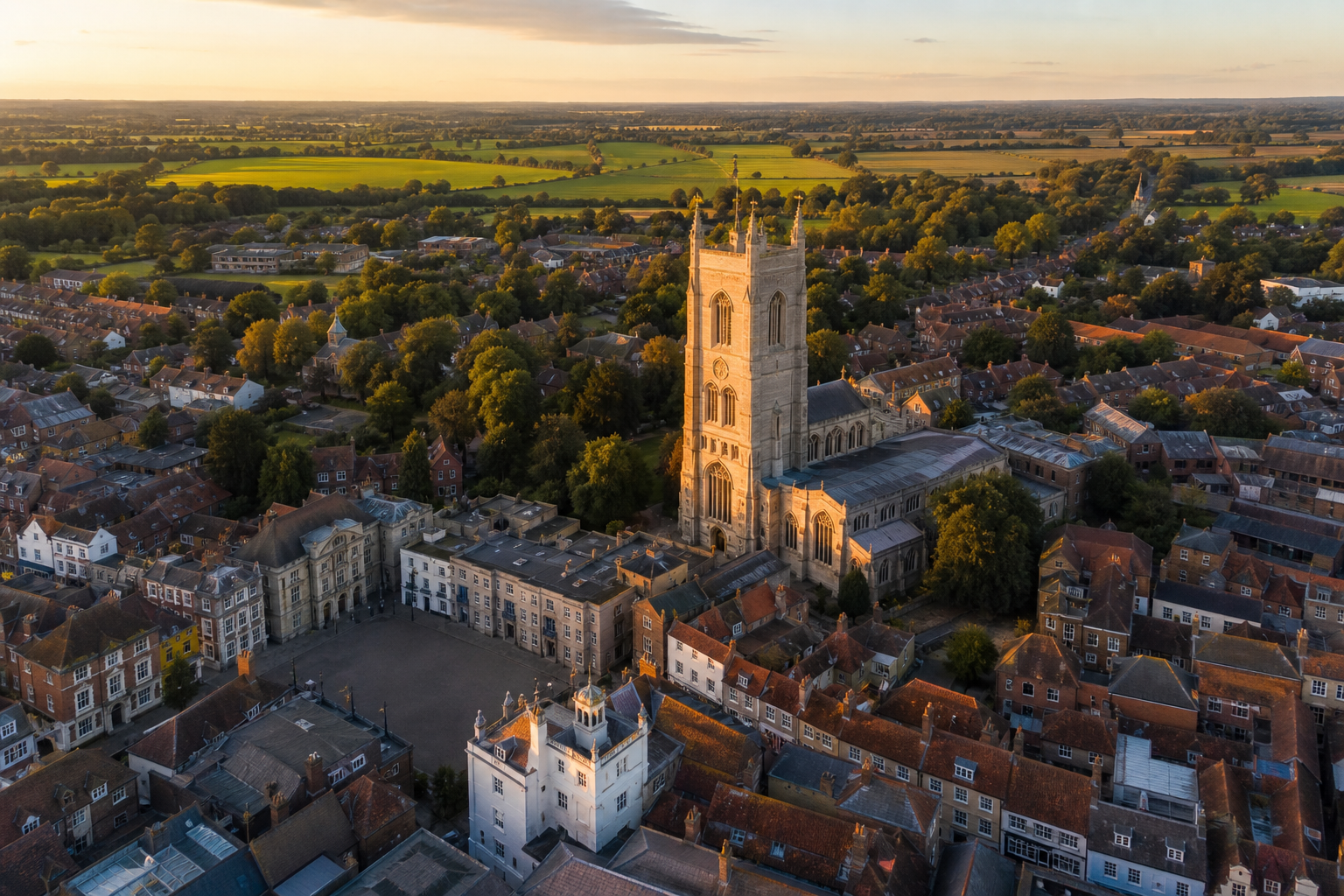
Suffolk’s inland market towns rarely make headlines. There is no dramatic coastline, no Georgian quayside to photograph at golden hour. What Bury St Edmunds, Stowmarket and the villages around Ipswich’s northern fringe offer instead is something quieter and, for many buyers, more valuable: genuine market towns with working high streets, direct trains into London, and a supply of period and family homes that has not yet been priced to match the coast.
For sellers, that gap is starting to close. As buyers priced out of Norfolk’s coastal premium and Cambridge’s commuter belt look further afield, inland Suffolk is quietly becoming the value alternative both counties have been missing.
Bury St Edmunds sits in West Suffolk, a district where the average house price stood at £297,440 to May 2026, up 2.3% year on year according to the UK House Price Index. Within the town itself, the picture is more nuanced. Construction Capital’s H1 2026 market report puts the median sale price at £288,000 across 1,205 transactions, down 4% year on year, while Rightmove’s rolling average for the town sits higher at £325,044 and AgentSeeker records an average sold price of £356,853 across 351 Land Registry transactions in the past twelve months.
That spread between median and average tells its own story. Bury St Edmunds is not a single market. Georgian townhouses around Angel Hill and the Abbey Gardens command a clear premium over the town’s newer estates, and detached homes average £400,000 against £170,000 for flats. Buyers moving from Cambridge or London for a slower pace, without giving up an active high street, theatre and independent shopping, are the ones driving demand at the top of that range.
Twelve miles south east, Stowmarket tells a different story again. Construction Capital’s H1 2026 figures show a median price of £300,000 across 1,294 sales, down 5.4% year on year, with detached homes averaging £418,000, semi-detached £260,000, terraced £225,000 and flats £140,000. AgentSeeker’s twelve-month average sold price is £299,849, sitting close to the median, which suggests a more consistent, less polarised market than Bury St Edmunds.
The falls in both towns’ year on year figures mirror what we are seeing across the wider Suffolk and Norfolk market this summer: a correction from the exceptional pricing of the past two years rather than a lack of buyer interest. Mid Suffolk district as a whole, which includes Stowmarket, actually shows average prices rising 4.2% year on year to £318,641, a reminder that town centre and rural figures within the same district can move in different directions.
The villages ringing Ipswich to the north and west are where inland Suffolk’s genuine premium shows up. Hintlesham, with its well-known manor and golf course, averages £485,417. Copdock, just off the A12, averages £492,500. Witnesham comes in at £390,400. These are not commuter dormitories in the generic sense: they are villages with their own pubs, churches and a sense of place, within easy reach of Ipswich station and the A14.
Ipswich itself remains comparatively affordable at an overall average of £264,441, with semi-detached homes averaging £266,888 and terraced houses £216,000-plus. That gap between the city and its surrounding villages, in some cases nearly double, is exactly the kind of differential that rewards sellers who present a village property properly rather than letting it compete on Ipswich’s own terms.
South west of Ipswich, Hadleigh and the wider Brett Valley offer a further variation on the theme. Rightmove’s twelve-month average for Hadleigh is £316,009, while AgentSeeker records a higher average sold price of £397,372 against a median of £325,000, again reflecting a market split between the town centre and the detached homes on its edges. OnTheMarket’s figure of £326,000 sits close to that median. Hadleigh’s timber-framed high street, one of the best preserved in Suffolk, continues to draw buyers who want a period property without the price tag of the Suffolk coast.
Bury St Edmunds carries genuine educational weight. King Edward VI School traces its royal charter back more than 450 years, and Culford School, an independent day and boarding school set in an 18th century mansion just north of the town, draws families from across East Anglia. For buyers relocating with children, that combination, alongside the town’s grammar-style state provision, is often as important as the property itself.
The commuter case for inland Suffolk is stronger than many buyers expect. Ipswich to London Liverpool Street takes as little as 58 minutes on the fastest services. Stowmarket to London is achievable in around 1 hour 10 minutes on the quickest trains, with an hourly service throughout the day. Bury St Edmunds is further out at roughly 1 hour 32 minutes on the fastest connection, still comparable to many outer London postcodes by journey time.
For buyers weighing Suffolk against Norfolk’s own commuter towns, this is a meaningful point of difference. Where North and West Norfolk buyers are often trading commute time for lifestyle, Stowmarket and Ipswich’s fringe villages let buyers keep a genuine London commute while paying materially less than Hertfordshire, Essex or even parts of Cambridgeshire.
The year on year falls recorded in both Bury St Edmunds and Stowmarket’s median figures are consistent with the wider correction across East Anglia this summer, not a sign of reduced buyer appetite. Transaction volumes in both towns, over 1,100 and 1,200 sales respectively in the past twelve months, remain healthy. What has changed is buyer expectation on price, and that makes accurate, evidence-based valuation more important than it has been for several years.
Properties that are priced against genuine comparable evidence, rather than last year’s asking prices, are the ones moving. Those that lean on outdated figures are the ones sitting unsold while the market resets around them.
A Georgian townhouse on Angel Hill, a converted barn near Hintlesham and a Victorian terrace in Stowmarket are three entirely different propositions, and they need to be marketed that way. The buyer for a period Bury St Edmunds property is rarely the same buyer looking at a family home in a Stowmarket cul-de-sac, even if both are technically within commuting distance of London.
That is the principle behind every property we bring to market: understand who is genuinely searching for a home like this one, and present it to reach them specifically, rather than relying on a generic listing to do the work. Suffolk’s market towns have the fundamentals, heritage, schools, and a commute that beats much of the South East on price. What they need is presentation that matches the value already sitting in the bricks.