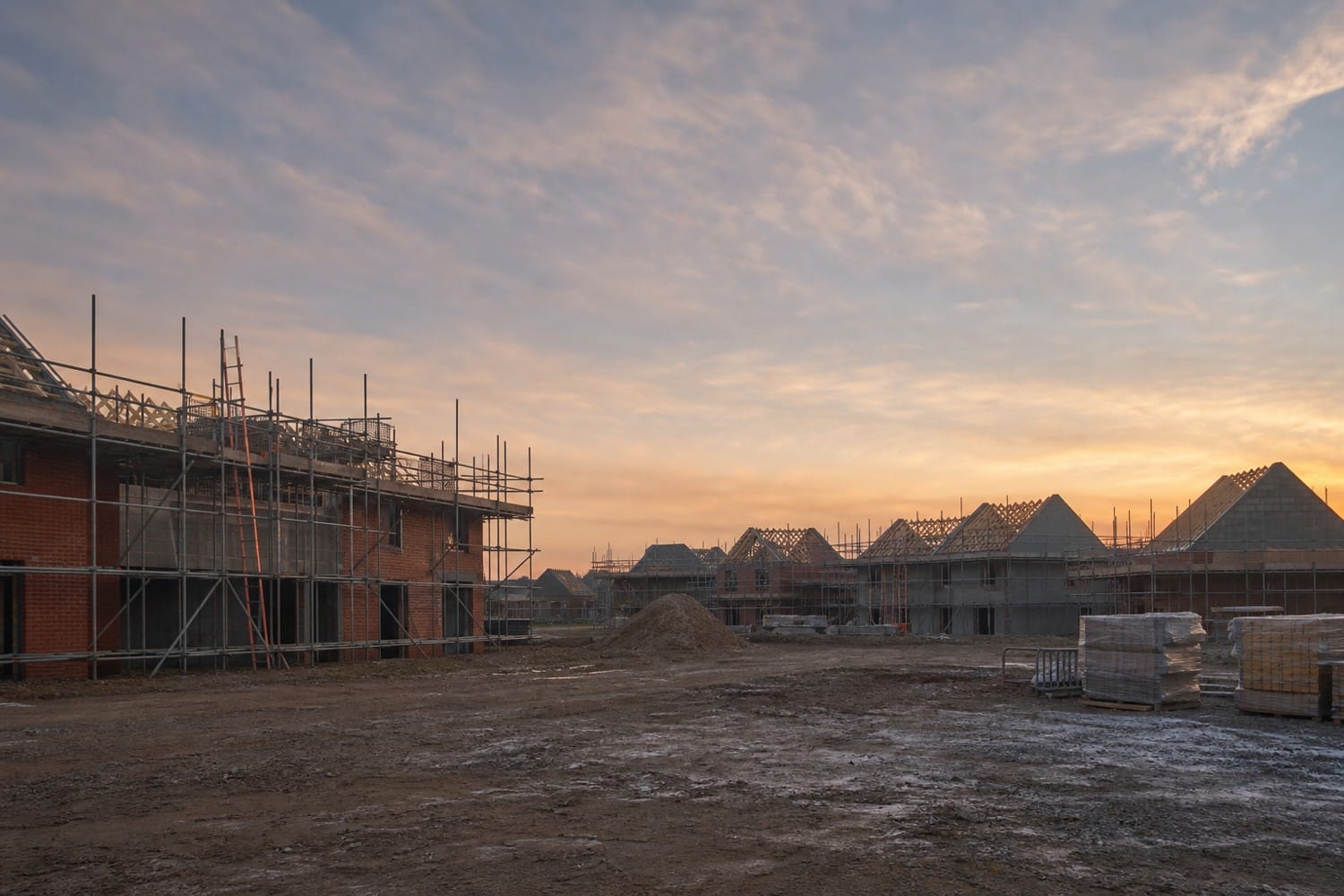
Taylor Wimpey has cut the number of homes it expects to build this year and asked the Government for direct help with buyer demand, including a return to something resembling Help to Buy. It’s a significant admission from one of Britain’s largest housebuilders, and it lands while ministers are still committed to a 1.5 million homes target that now looks arithmetically out of reach.
In March the company guided to 10,600 to 11,000 completions for 2026, itself around 4% below its 2025 output. It now expects between 10,600 and 10,800, excluding joint ventures. First-half completions came in at 4,986 homes, down from 5,264 in the same period last year.
The financial picture explains the caution. Operating profit for the first six months fell 19% to £130 million, even as revenue edged up 2% to £1.68 billion. Selling much the same volume for slightly more money while earning meaningfully less of it tells you what has happened to build costs and to the incentives being offered to get buyers over the line.
The company’s statement was carefully worded but the message was unmistakable. “We continue to support the Government’s housing ambition,” it said. “However, without targeted demand support and viability measures to unlock delivery, weaker demand, rising costs and limited affordable housing funding risks reducing sector output and UK economic growth.”
Translated: without a demand-side subsidy, we will build fewer houses.
Research published in June by one of the major national agencies forecast that new-build completions in England will average 167,500 a year over the coming years, against a stated ambition of 300,000. On that path, roughly 837,500 homes get built in the five years to 2029/30, leaving the 1.5 million target short by more than 660,000.
Numbers of that size stop being a policy debate and become a structural fact about supply. Build-to-rent starts have also dropped sharply this year, removing another delivery route that had been quietly picking up some of the slack.
The counties have a particular relationship with new development. Volume housebuilding here clusters around the larger towns and the A11 and A47 corridors: Wymondham, Attleborough, Thetford, the edges of Norwich and King’s Lynn. Away from those, in the villages of north Norfolk and coastal Suffolk, meaningful new supply barely exists and won’t arrive in the next cycle either.
That divide has consequences. In areas with a steady pipeline of new stock, second-hand sellers compete directly against a builder who can offer a part-exchange, pay stamp duty, throw in the flooring and complete on a date certain. Fewer sites and fewer completions means less of that competition, which is quietly helpful for anyone selling an established family house in a growth town.
In the villages, the effect runs the other way. Where nothing new is built and existing owners stay put for well over a decade, the constraint on transactions is availability rather than demand. A shortage of new homes in Cambridgeshire or Essex does not release a single additional cottage near Burnham Market. It simply pushes more of the same buyers towards a fixed pool of period property.
Taylor Wimpey’s call for a scheme like Help to Buy is understandable from where it sits, though the previous version’s record is mixed at best. It supported volumes, and it also lifted new-build prices. Buyers who purchased at a premium then discovered on resale that the premium was attached to the incentive rather than the building.
Government figures on the old scheme have shown it turning a profit for the Treasury, which strengthens the political case for a successor. If one arrives, the practical effect for Norfolk and Suffolk owners would be concentrated where new-build supply is concentrated. It would do very little for the £900,000 barn conversion or the coastal house, other than to firm up the bottom of the chain that those sales ultimately depend on.
That last point deserves more attention than it usually gets. Prime sales in these counties are rarely blocked by a shortage of prime buyers. They stall because someone four links down cannot complete. Anything that gets first-time buyers moving, whether a deposit scheme, the recent loosening of loan-to-income limits, or simply cheaper two-year money, reaches the top of the market eventually.
Which is why a housebuilder’s profit warning is not just news for the new-build sector. Weaker volume housebuilding means fewer entry-level completions, slower chains, and more transactions that depend on a buyer who is already a homeowner.
The autumn Budget is the obvious pressure point. Housebuilders have made their position public, the delivery gap is now well documented, and the Treasury has a target it cannot hit with planning reform alone. Some form of demand support looks more likely than it did six months ago.
For anyone weighing up a move in Norfolk or Suffolk this year, the useful takeaway is narrower than the headlines suggest. Local evidence matters more than national forecasts, which is what our 324 property market reports track at village and postcode-sector level. Whether a builder in the Midlands cuts its output by 200 homes will not change what a Georgian rectory is worth. What happens to the entry-level market on the edge of the nearest town might.