
Mortgage rates fell across every deposit level this week, with multiple lenders trimming fixed-rate deals in a competitive push for summer borrowers. For Norfolk buyers and sellers, this is the most significant rate movement since the spring, and it arrives at a time when political uncertainty might have been expected to push costs higher.
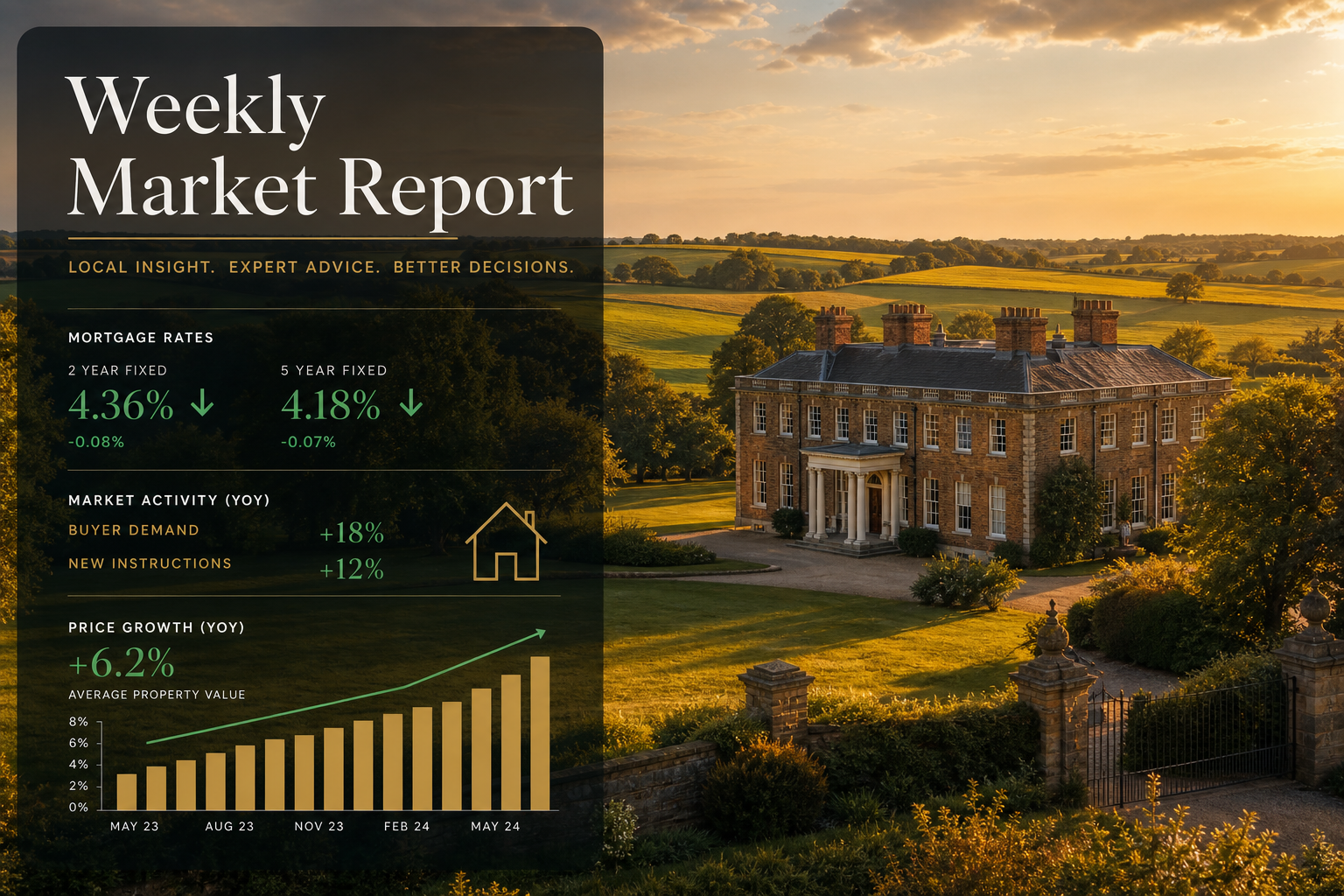
Rightmove’s daily mortgage tracker, updated on 24 June, shows a clear pattern: rates have fallen at every loan-to-value band over the past week. The average two-year fixed rate now stands at 5.02%, down from 5.18% a month ago. Five-year fixes have dropped to 5.01%.
At the sharp end of the market, the best available two-year fix is now 4.30% from Barclays at 60% LTV, with HSBC matching at 4.30% and NatWest close behind at 4.31%. For five-year fixes, Barclays leads at 4.33%, followed by NatWest at 4.34% and HSBC at 4.35%.
The biggest improvements came for first-time buyers. At 95% LTV, the lowest two-year fix fell 0.17 percentage points in a single week, from 5.25% to 5.08%. Five-year fixes at the same deposit level dropped 0.16 points to 5.07%. These are meaningful reductions that translate directly into lower monthly payments and expanded borrowing capacity.
Nationwide, NatWest, Barclays, TSB and Santander have all cut selected fixed rates during June. Nationwide’s lowest rate now sits at 4.29% for home movers at 60% LTV, making it the cheapest two-year fixed deal on the market for that segment.
Keir Starmer resigned as Prime Minister on 22 June, following a period of internal party pressure. Markets largely took the news in their stride. The 10-year gilt yield eased to around 4.82% on the day of the announcement, and sterling held steady at roughly $1.32. The FTSE 100 edged higher.
For mortgage borrowers, the key point is that fixed-rate pricing follows swap rates, not headlines. Swap rates moved up only one to two basis points on the news, which is negligible. The political transition has, so far, had no material effect on what it costs to fix a mortgage.
The end of the Iran conflict and the reopening of the Straits of Hormuz is arguably more significant for the housing market. Falling oil prices reduce inflationary pressure, which in turn gives the Bank of England more room to hold or eventually reduce the base rate. The current rate stands at 3.75%, held by a 7-2 vote on 18 June, with two MPC members preferring an increase to 4%.
CPI inflation was 2.8% in the year to May, still above the Bank’s 2% target. The next rate decision is on 30 July. Market expectations remain divided: roughly 46% expect at least one hike before the end of the year, 43% expect a hold, and 11% see a cut.
HMRC recorded 101,030 residential property transactions in April, a 3% decline on the previous month. Meanwhile, data from property analytics firm TwentyEA shows that sales agreed fell 8.1% year-on-year in May, to 109,922, down from 119,607 in the same month last year.
TwentyEA has revised its full-year transaction forecast from 1.2 million to 1.13 million, a 6.8% fall compared with 2025 but still 2.6% higher than 2024. New instructions are at record levels, which means more choice for buyers and more competition among sellers.
The picture is consistent across multiple data sources: activity is steady rather than surging, and well-priced properties continue to transact while overpriced stock lingers. The gap between realistic pricing and aspirational pricing is wider than it has been for several years.
GetAgent’s latest data shows the average asking price across Norfolk at £323,949, with properties spending an average of 15 weeks on the market before going under offer. Asking prices have adjusted by -2.9% over the past six months, reflecting sellers who are pricing more competitively to attract committed buyers.
By property size, average sold prices in Norfolk range from £150,860 for one-bedroom homes through to £752,160 for five-bedroom properties. At the four-bedroom level, the average sits at £490,308, and detached homes across the county average £359,163.
ONS data for April 2026, the most recent available, shows the East of England recording 3.8% annual growth to an average of £336,000. This is broadly in line with the UK-wide figure and reflects the ongoing base effect from the stamp duty changes in April 2025, when prices dipped temporarily before recovering.
Across the 324 local markets we monitor throughout Norfolk and Suffolk, conditions continue to favour buyers in the majority of areas. The average SSTC rate sits at 20%, meaning more than 80% of listed properties have yet to find a buyer. The average time on market across all monitored locations is 317 days.
Of the 324 areas tracked, 256 currently favour buyers, 53 are balanced and just 15 are sellers’ markets. This is a market defined by local variation, and understanding the specific conditions in a given village or town makes a measurable difference to outcomes.
The strongest seller conditions are found in Alburgh, where 58% of properties are under offer, and Drayton at 55% SSTC. Alpington, Brandon and Kirstead each show 50% of stock under offer.
The fastest-selling area is Bramerton, where properties are moving in an average of just 24 days. Terrington St Clement follows at 36 days and Hempnall at 37 days.
At the other end of the spectrum, parts of the North Norfolk coast remain firmly in buyer territory. Blakeney, Brancaster and Burnham Deepdale all show 0% SSTC, with stock sitting for extended periods. These are areas where second-home tax reforms and elevated asking prices continue to weigh on activity.
The mortgage rate reductions are positive for sellers, because lower rates expand the pool of buyers who can afford to move. When the average monthly payment drops by £30 or more, as Rightmove estimates, it brings some transactions back within reach that were previously marginal.
However, with 256 out of 324 local markets favouring buyers, pricing accuracy remains the single most important factor in achieving a sale. Properties entering the market at a realistic price are moving. Those testing the water at aspirational levels are contributing to the 80% of stock that remains available.
The data shows a 3.1% average asking price reduction across Norfolk, according to GetAgent. Sellers who price correctly from the outset avoid the damaging cycle of listing, sitting, reducing and losing buyer confidence.
Buyers are in a strong position. Stock levels are elevated, SSTC rates are low, and mortgage rates are improving week by week. The combination gives buyers genuine choice, negotiating room and improving affordability.
The sharpest improvements in rates are at the higher LTV bands, which is particularly relevant for buyers stretching into Norfolk’s premium market. A five-year fix at 75% LTV has dropped to 4.82%, down 0.08 percentage points in a single week. At 60% LTV, the average five-year fix now sits at 4.53%.
With properties across the region averaging 317 days on market, there is no urgency to rush. Take the time to negotiate, instruct thorough surveys and ensure the property represents genuine value. In areas like Norwich, where the SSTC rate stands at just 10%, the leverage sits firmly with the buyer.
HMRC’s monthly property transaction data for May is due on 30 June, which will provide the clearest picture yet of activity since the BoE’s June hold. The Halifax June House Price Index, expected in early July, will be the first major index to reflect a full month of trading after the Starmer resignation and the Iran ceasefire.
The next Bank of England rate decision on 30 July will be critical. If inflation continues to ease alongside falling oil prices, the case for holding at 3.75% strengthens. For Norfolk buyers and sellers, the direction of travel on mortgage rates over the next five weeks will shape the second half of 2026.
For a detailed view of your local market, explore our Property Market Reports covering 324 towns and villages across Norfolk and Suffolk.