
Private rents are climbing again. Average UK monthly private rent increased by 3.7% in the 12 months to July 2026, reaching £1,393, and the direction of travel is firmly upward. The increase was the highest annual rate of rent inflation since December 2025, driven mainly by an acceleration in London, where annual growth rose from 2.2% to 3%. Set against that, the sales market told a quite different story. Average UK house prices increased by just 2.0% in the 12 months to June 2026 to £272,000, down from 3.0% in May. Two markets, diverging sharply.
House price annual inflation slowed sharply in June 2026 because price growth has been weaker this summer than it was last year, in the months following the April 2025 Stamp Duty Land Tax changes in England and Northern Ireland. That context matters enormously when reading the headline figure. Between May and June, average prices rose by just 0.1%, against a 1% rise in the equivalent month a year earlier. The comparisons were always going to be tough. The comparatively strong figures recorded in May and June 2025 reflected a rebound following a sharp price fall in April 2025, which coincided with the SDLT changes that took effect on 1 April 2025.
Strip out that base effect, and what you’re left with is a market that is subdued but not in freefall. Richard Donnell, executive director of research at Zoopla, explained that higher mortgage rates were behind the slowdown, saying: “Housing sales market activity has been hit hard over the summer by higher mortgage rates which have hit buying power and slowed price inflation.” That combination of a challenging base period and elevated borrowing costs has done much of the damage to the annual figure.
The North West recorded the strongest annual house price growth among English regions at 4.7%. At the other end of the spectrum, London remained the weakest market, with average prices falling 2.5% year-on-year, the tenth consecutive month of annual house price declines in the capital. England as a whole recorded more modest progress: house prices increased by 1.8% annually to £293,000.
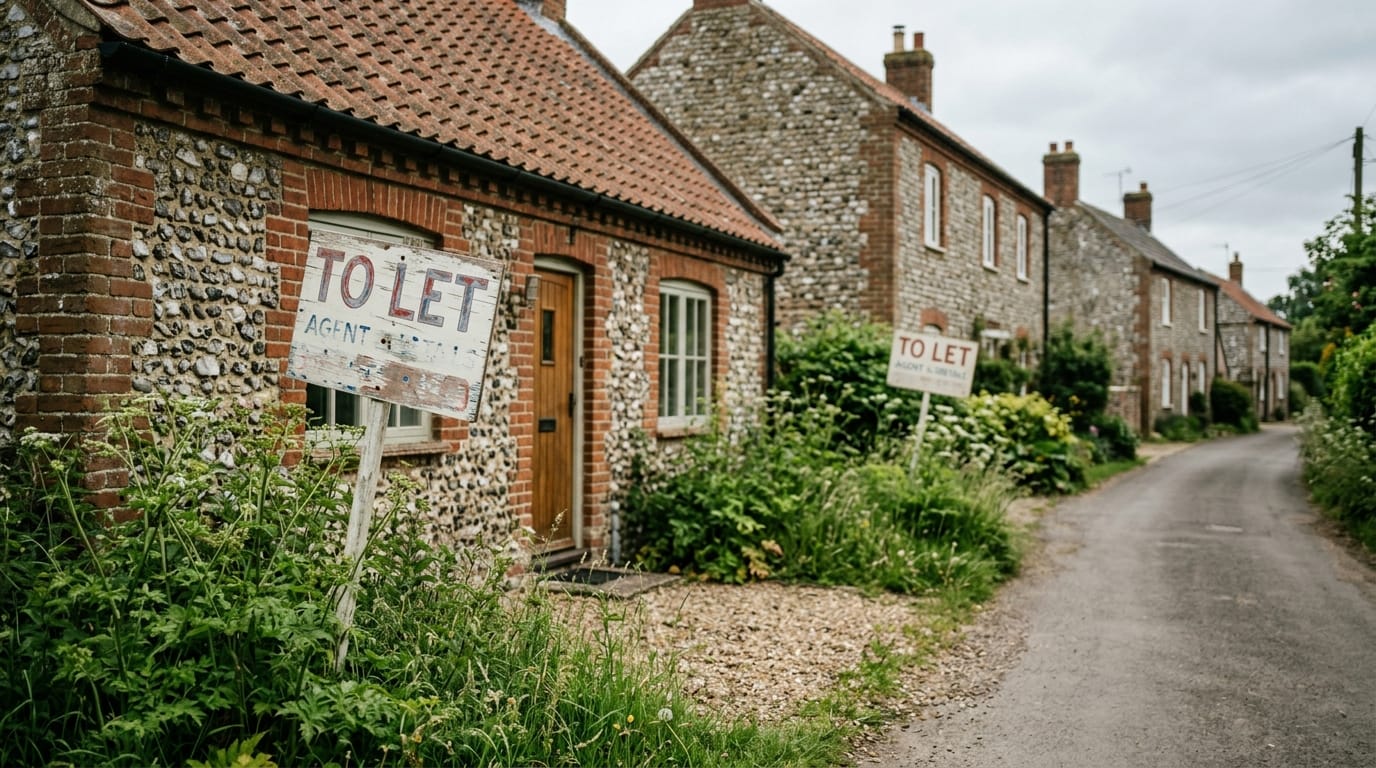
While buyers weigh up affordability and wait for borrowing costs to ease, the pressure on renters is intensifying. Average rents in England reached £1,451 after rising 3.8% year-on-year, while Wales recorded a 4.5% increase to £843 and Scotland a 1.7% rise to £1,016. The North East recorded the strongest rental growth among English regions at 6.3%, while the South East had the lowest at 2.9%. East Anglia, sitting broadly within the South East and East of England corridor, is experiencing pressures that fall somewhere between those two poles, but the direction is unmistakably upward.
Supply is a large part of the problem. The latest Propertymark report found letting agents have an average of just 12 properties per branch, compared with 98 prospective tenants. That is a significant imbalance, and in many areas good rental properties simply do not stay available for long. Nationally, there are an average of seven people registering their interest in each available property at many letting agency branches, with intense pressure remaining on the supply of suitable rental homes.
The Renters’ Rights Act brought major changes to England from 1 May 2026. Described as the most significant reform to renting in a generation, it abolishes Section 21 no-fault evictions and introduces rolling periodic tenancies, alongside a ban on rental bidding wars and stronger requirements for evidence-based rent increases. The legislation’s stated aims are admirable. Its market consequences are proving more complicated.
Tom Bill, head of UK residential research at Knight Frank, was direct in his assessment. He said: “Rents are being pushed higher as the unintended consequences of the Renters’ Rights Act play out. Some landlords have left the sector, which has reduced supply, while others have increased asking rents to reflect the additional financial risks they face. The consequences may be unintended, but they were not unexpected, and a policy designed to tip the balance of power towards tenants is adding to the financial pressures they already endure.”
The scale of that landlord retreat is considerable. Research from specialist buy-to-let lender Pepper Money suggests around 220,000 households, roughly 5% of the private rented sector, could leave the sector by the end of 2026. More than 65,000 of those exits are the direct result of the Renters’ Rights Act. Pepper Money’s research also indicates that single-property landlords are twice as likely to sell up as those with two or more units, meaning it is the small, accidental landlord, often the backbone of rural rental supply, who is most likely to exit. In Norfolk and Suffolk, where the private rented sector has long been dominated by smaller portfolios rather than institutional operators, that matters considerably. In North Norfolk alone, census data from 2021 showed that 17.7% of households were in private rented properties, a level of dependence on the private sector that makes any contraction in landlord numbers acutely felt.
For buyers and sellers across Norfolk and Suffolk, the immediate picture in the sales market is one of patience rather than urgency. The volume of stock on the market has been elevated. 2026 began with the highest level of homes for sale in over eight years, with the average agent marketing 32 properties. That supply improvement has given buyers more choice and more room to negotiate, useful conditions when mortgage costs remain a constraint on household budgets.
For those caught on the wrong side of the rental-sales divide, however, conditions are genuinely difficult. Tenants who cannot yet afford to buy are competing for a shrinking pool of rental stock, paying more each month in real terms, and finding it harder to accumulate the savings needed for a deposit. That dynamic is self-reinforcing: rising rents suppress deposit formation, which delays the transition into ownership, which sustains demand in the rental sector, which pushes rents higher still.
The position in London illustrates what can happen when that cycle runs unchecked for long enough. London remains the most expensive region to rent, with an average monthly cost of £2,317, compared with just £783 in the North East. East Anglia is not London, the affordability gap with the capital remains one of the reasons people have been relocating here for years. But the structural forces now at work in the rental sector are national, and Norfolk and Suffolk are not insulated from them.
Northern Ireland offers a reminder that the national picture is rarely uniform. Northern Ireland recorded considerably stronger growth in house prices, with average prices rising 9.2% annually to £202,000 in the second quarter of 2026. That level of growth would look remarkable anywhere else on the map right now. It underlines the degree to which different factors, wage growth, housing supply, demographic pressure, can produce very different outcomes within the same statutory framework.
What the ONS data for July and June 2026 reveals, taken together, is a property market in the middle of a structural realignment rather than a cyclical blip. The sales market is digesting the aftermath of the stamp duty distortions that ran through 2025. The rental market is absorbing the consequences of the most significant legislative overhaul of the private rented sector in decades. Neither process will resolve quickly. As mortgage rates settle and lenders respond to shifts in the broader interest rate environment, the sales market should find a firmer footing. The rental market’s path to stability is less clear, and will depend substantially on whether new supply, from build-to-rent, from institutional landlords, or from a renewed confidence among private investors, can emerge at anything like the pace needed to meet demand.
That gap between what renters need and what the market currently offers is the defining tension of this moment. Until it closes, rents will keep rising.