

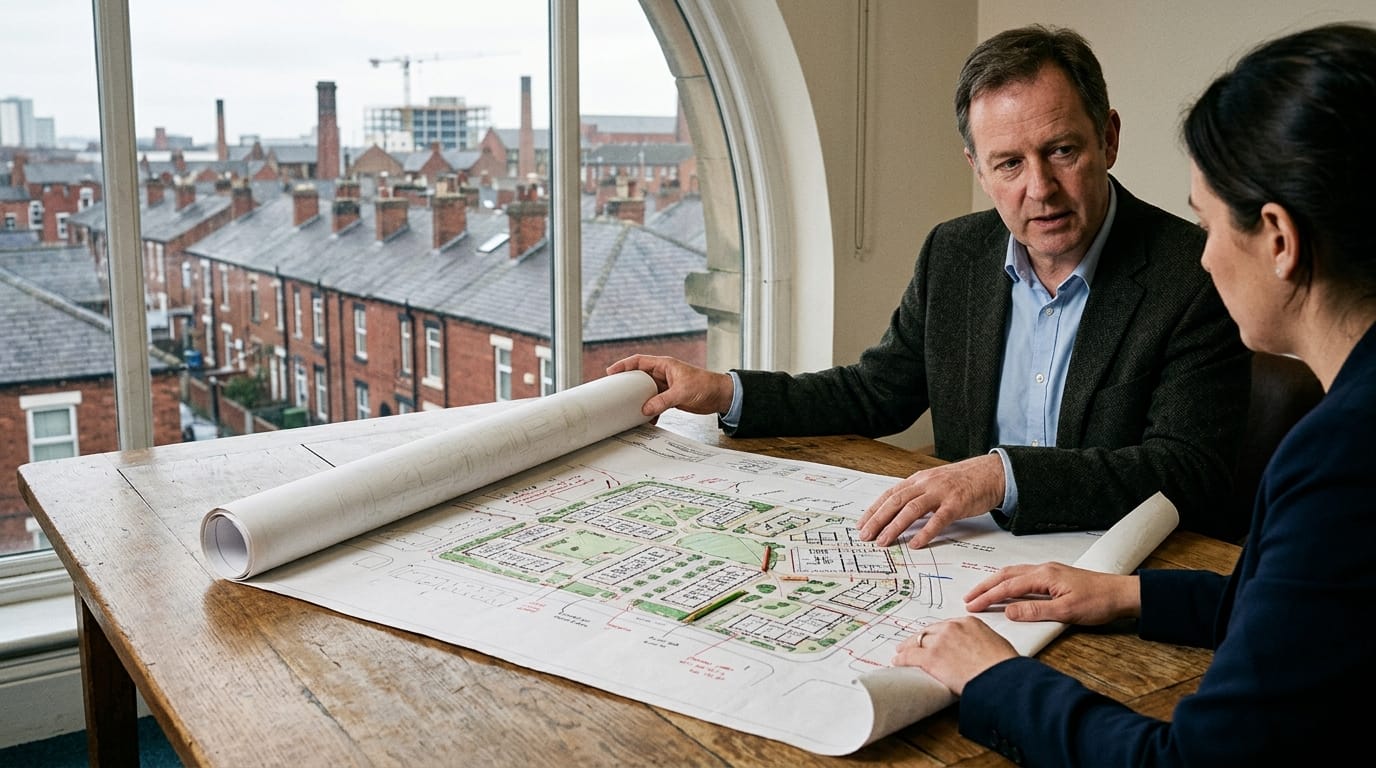
England’s planning system changed shape on 23 August 2026. Regional mayors across England are set to be handed sweeping “call-in” powers to greenlight large-scale developments, bypass local blocks, and accelerate the government’s housebuilding targets. The proposals, announced by Prime Minister Andy Burnham and his housing minister Matthew Pennycook, represent the most significant reconfiguration of development control outside London in a generation.
The changes will give elected mayors in 13 combined authority areas powers similar to those already held by London Mayor Sir Sadiq Khan, allowing them to “call in” major planning applications for their own consideration rather than leaving decisions entirely in the hands of local councils. The thresholds are precise and, by design, targeted at the developments most likely to transform places: schemes with more than 150 homes, more than 15,000 square metres of commercial space, or any building over 30 metres or taller, roughly ten storeys, will be in scope.
The move has been backed by ten mayors from different parties and will bring mayors across the country in line with powers the Mayor of London already has. That cross-party endorsement matters. Planning reform has a habit of collapsing under the weight of political opposition; this one arrives with at least the framework of consensus already in place.
Under proposals to be published next week, a mayor will be able to take over key planning applications which impact on local growth, and direct a council to take it forward or refuse it. That distinction – the power to direct refusal as well as approval – is easily overlooked but important. This is not simply a developer’s charter. Mayors will be able to shape the character of major schemes, not merely wave them through.
Beyond the call-in mechanism itself, the move would see mayors allowed to direct councils to take decisions forward or refuse them, and they would also be able to grant upfront permission so developers can start building without having to apply. That second power – upfront permission – is arguably the more radical of the two. It removes one of the most significant friction points in the development pipeline: the application itself. For sites where the principle of development is well established, it could cut years from delivery timelines.
Mayors will also get a “bigger say” over how housing funding is spent in their area, with the government directing national agency Homes England to focus on local mayors’ priorities. Mayors will also get more of a say on how national housing funding from Homes England will be spent in their areas and they will be able to charge a levy on development to fund major infrastructure. The combination of planning authority and fiscal influence is potent. Control over where money flows, as much as where planning permission lands, is what determines whether strategic sites actually get built.
The government points to London as evidence that call-in powers work. Sir Sadiq Khan was already given the powers earlier this year in what was billed as an emergency measure aimed at unblocking dozens of stalled sites to get thousands more affordable homes built in the capital. Housing minister Pennycook insists the mechanism has helped the mayor “unblock strategic growth sites” in the capital, even as overall housebuilding figures in London have fallen in recent years. That tension – between the process improvement the powers offer and the structural challenges that continue to suppress delivery – sits at the heart of the debate.
Critics were quick to note the London parallel cuts both ways. The Liberal Democrats warned that transferring authority away from local councillors could weaken community involvement in planning decisions. The party’s housing and planning spokesperson Gideon Amos put it bluntly: “Taking powers away from communities and local councillors is taking powers away from local people. This plan is a direct attack on communities across the country.”
The Conservatives questioned whether it was right for councils to lose the “ability to make planning decisions in their own communities”. Paul Bristow, the Conservative mayor of Cambridgeshire and Peterborough, offered a more nuanced position: he told the BBC that if he had the call-in power, he would use it to unblock schemes he believed had strong merit, but stressed the approach would be “much more light touch” than London’s. He argued it was not about overriding communities but about giving developers and councils a framework for compromise rather than outright refusal.
In the 2024 general election, the Labour government promised to build 1.5 million homes in England by the end of the decade, but housebuilders have warned the target could be missed. The government is just over a quarter of the way to its target to build 1.5 million homes in England in five years. That gap between promise and progress explains the urgency behind this announcement.
Pennycook’s language was frank. He acknowledged the target was “really stretching” but made the moral case for it: nearly 180,000 children are currently living in temporary accommodation, he said, making the need for additional housing particularly urgent. “Any smaller target wouldn’t be commensurate with the scale of the challenge,” he added. Bristow, for his part, was blunter still, saying the government had “no chance whatsoever” of meeting the figure. Whether or not one accepts that assessment, the arithmetic is uncomfortable, and these powers are plainly designed to accelerate delivery rather than simply shift who signs off on it.
The government has already set out a broader push to hand more powers, funding and responsibility to English mayors. Under that plan, mayors will keep a share of income tax and business rates revenues, part of what ministers have called the biggest transfer of power from Westminster in a generation. The planning reforms announced this week sit within that larger devolution project – one that Prime Minister Burnham, who spent nearly a decade as Greater Manchester’s mayor before entering Downing Street, has made a defining feature of his administration.
Norfolk and Suffolk sit outside the combined authority structure that will initially receive these powers. The powers will be available to mayors in the combined authorities in North East England, South Yorkshire, West Yorkshire, York and North Yorkshire, Hull and East Yorkshire, Greater Lincolnshire, Cambridgeshire and Peterborough, East Midlands, and Tees Valley – as well as the larger city-region mayors in Manchester, Liverpool and elsewhere. East Anglia does not yet have a comparable mayoral structure, which means the direct application of call-in powers to this region remains some way off.
That does not make the story irrelevant here. Quite the opposite. The policy signals a national direction of travel that will shape investment decisions, housebuilder strategies and land values across England, including in markets like ours where average prices currently sit at around £390,000. Our market data tells its own story: an average of 289 days on market and an SSTC rate of 28% across 31 monitored areas indicate a market that is measured and selective, one where supply constraints and buyer caution coexist. The underlying demand for family homes is real – the policy context framing that demand is shifting fast.
Critics warn the reforms risk creating a two-tier system, where planning rights depend on whether your region happens to have adopted the mayoral model. That is a legitimate concern and one that will grow louder if combined authority areas begin to deliver homes at materially faster rates than counties and districts operating under the traditional system. The pressure on areas like Norfolk and Suffolk to seek their own devolution arrangements – or face a competitive disadvantage in attracting both residents and investment – may intensify as a result.
The government has stressed that local councils will continue to decide the majority of applications and that all decisions must still follow planning rules. A formal consultation on how the powers will work is due to be published imminently, and the detail of that document will be critical. Much depends on how broadly mayors choose to interpret their new authority, and whether the upfront permission mechanism can in practice unlock sites that have been stalled for years.
What is clear is that England’s planning system is being rewritten from the top down as well as the bottom up. For those operating in property markets across the country, the question is not whether this reform matters – it plainly does – but how quickly its effects make themselves felt in the land, development and sales markets that follow every major shift in planning policy. The consultation due next week will be required reading for anyone with a serious interest in where English housing goes from here.