

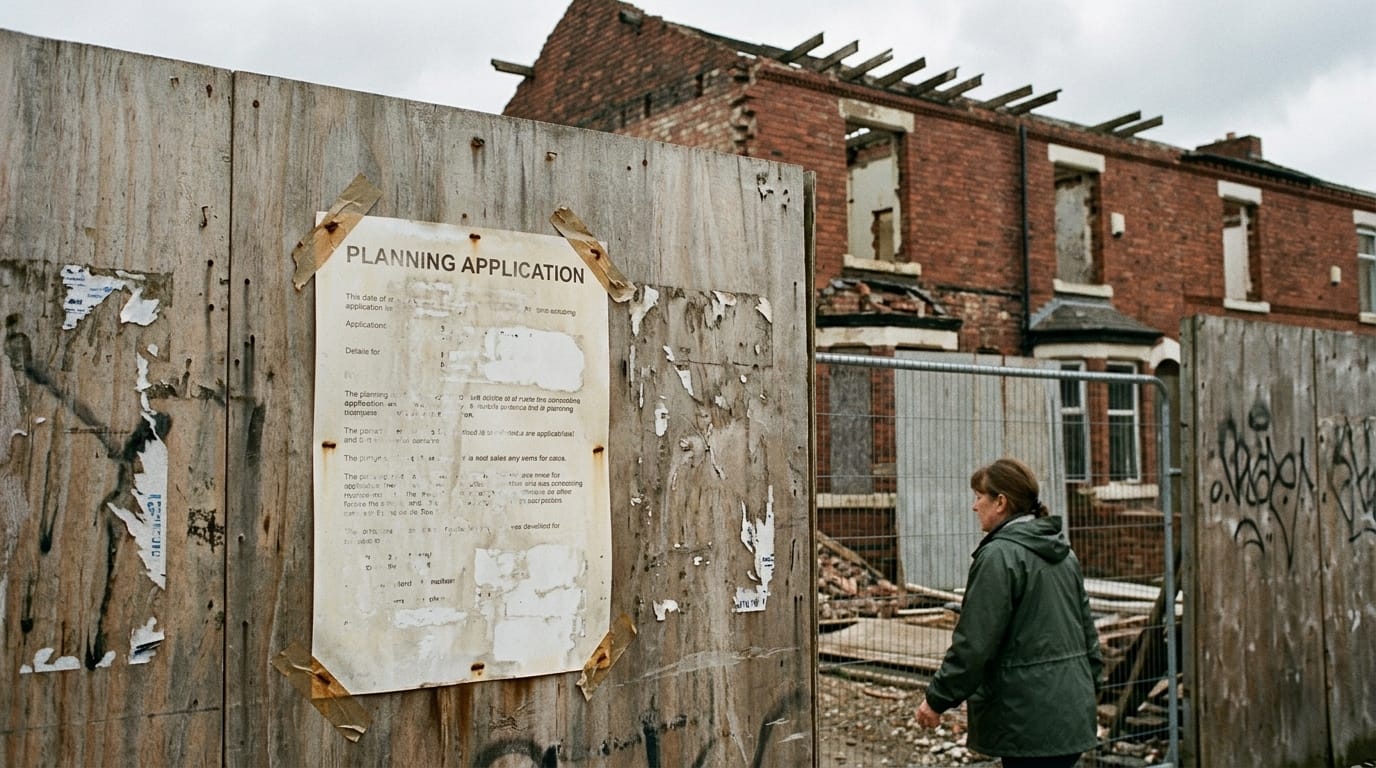
A letter published in the Guardian this week has done something that years of policy debate has largely failed to accomplish: it has stated the accountability problem with social housing plainly, in a single paragraph. Marco Scalvini, writing in response to the paper’s editorial on London’s housing crisis, argues that a home is counted as affordable on the day planning permission is granted, and is rarely examined again. Not at completion. Not when tenure changes. And not when service charges quietly make it unaffordable within months of a family moving in.
That argument deserves a wider hearing. It reaches well beyond the capital.
The fundamental issue is deceptively simple. Affordable homes are logged as policy commitments at the moment a planning application is approved. What happens between permission and occupation – and in the decades that follow – goes largely untracked by any public register. Scalvini’s letter notes that infrastructure is normally monitored and social housing is not, either when it is delivered or across the years in which it is meant to remain affordable.
That gap between promise and record has produced some striking outcomes. The most cited case is Elephant and Castle, where – as Scalvini documents – residents spent three years pursuing freedom of information requests to extract the viability evidence behind an affordable housing commitment that ultimately delivered 82 social rented homes in place of more than a thousand. Parliamentary evidence submitted to the Commons confirms the broad picture: over 1,000 council tenants were moved off the Heygate estate, but the developer claimed it would only be viable to replace 83 homes at social rents. A viability assessment was produced to support that claim. It was not, for a long time, publicly accessible.
By the time the information came out, the estate had already been demolished. A record that arrives after demolition, as Scalvini pointedly observes, can only count the losses.
What makes the situation particularly frustrating is that the financial transparency is, in one sense, already there. Scalvini notes that Southwark, like almost every local authority, publishes every pound of the financial contributions developers pay. The S106 money is visible. What is missing is any scheme-level account of whether the promised social rented homes were actually built.
This is not a small administrative gap. It is the difference between knowing the price paid and knowing what was delivered. Knowing that a developer wrote a cheque tells you nothing about whether families who needed social housing were actually housed.
Southwark’s Old Kent Road Area Action Plan outlines a major redevelopment blueprint aiming to construct 20,000 new homes, and its future now rests before a government Planning Inspector following formal objections from residents, business owners, and housing advocates. Since around 2018, there has been a significant acceleration in construction underpinned by the Area Action Plan, with around 3,258 homes currently under construction, of which approximately 1,980 are affordable. The scale of what is still to come makes the absence of a proper delivery record all the more significant. Scalvini’s point is that on the Old Kent Road, where construction is still in its early stages, the record could still be established in time to shape what is built – not merely to catalogue what was lost.
It would be unfair to suggest that nothing is moving on transparency in social housing more broadly. The Regulator of Social Housing has unveiled new measures to promote transparency for social housing tenants in England, due to come into force from October 2026 and introducing a standalone Competence and Conduct standard. RSH Chief Executive Jonathan Walters has said that greater transparency, stronger accountability and a stronger tenant voice are at the heart of these changes.
Meanwhile, the government has also committed to extending the Freedom of Information Act to cover Tenant Management Organisations with local authority landlords, enabling tenants of those bodies to request access to information about their homes in the same way as other local authority tenants. These are genuine steps. But they address the conduct of landlords once homes exist. They do not, as yet, create the kind of scheme-by-scheme delivery register that Scalvini is calling for – one that tracks what was promised at planning, what was built, and what it actually costs to live in.
A parliamentary amendment to the Social Housing Bill has sought to require local housing authorities to maintain and publish annual registers recording dwellings sold under right to buy against new social housing provided, enabling public scrutiny of whether authorities are failing to replenish lost stock. That is a partial answer. It addresses one form of depletion. It does not close the gap between planning permission and physical delivery across the far larger volume of Section 106 obligations.
The accountability deficit Scalvini describes is not confined to inner London regeneration zones. It runs through every local authority where affordable housing is secured as a condition of private development – which is to say, almost everywhere.
In Norfolk and Suffolk, the dynamics are different in character but not in kind. Work has recently started on a housing scheme in Norwich that will deliver 127 new social homes, transforming a former county council-owned brownfield site into a new community of high-quality, affordable homes, all available at social rent. Norfolk County Council is investing £5.5 million in the scheme through its Independent Living and Supported Living capital programmes, with the remaining cost funded by Places for People with support from Homes England. That is direct, publicly funded delivery – the kind where accountability is relatively straightforward because the money trail is clear.
Section 106 delivery is harder to trace. Providers such as Saffron Housing are dedicated to building and buying affordable homes across Norfolk and Suffolk, acquiring stock through Section 106 – the clause in the Town and Country Planning Act 1990 that determines the number of affordable homes built within a new development. But as with Southwark, the public record of whether each scheme has delivered its promised quota of social rent homes – as opposed to intermediate products or shared ownership – remains patchy at best. North Norfolk acknowledges there is a severe shortage of homes in the area, and that most applicants on the housing list will have to wait a long time for rehousing. Waiting lists are a symptom. The underlying data on whether committed affordable homes are actually materialising is much harder to find.
As of July 2025, the Greater Norwich Authorities reported a 4.85-year housing land supply, meaning they cannot demonstrate a full five-year supply. Development across much of the area continues to be frustrated by delays from Nitrate Neutrality requirements, following Natural England’s advice. Those constraints affect total supply. They also mean that every affordable home promised within a consented scheme carries even greater weight – which makes tracking delivery more important, not less.
Scalvini closes his letter with a comparison that has real resonance. He recalls the Guardian editorial’s invocation of Nye Bevan’s idea of housing as an essential service, comparable to the NHS. His response is pointed: the NHS publishes waiting lists and inspection results, and is held to them. Housing has no equivalent, whoever the landlord is.
That asymmetry is not inevitable. The Regulator of Social Housing identified serious failings in delivering the Transparency, Influence and Accountability Standard during a planned inspection in March 2026 – evidence that the inspection regime, where it reaches, does find and name problems. What is missing is the equivalent of a hospital’s admitted waiting list: a public, dated, scheme-level record of what each development promised, what it delivered, and what a tenancy in it now costs.
Shared ownership has already illustrated why that third element matters. The product is counted as affordable at the point of planning. The service charges and staircasing costs that can make it genuinely unaffordable within months of occupation go largely unrecorded in any public register. That is not a theoretical concern in this region. It is a live question for buyers and renters across East Anglia who are weighing up whether a shared ownership product labelled affordable actually is.
The argument for transparency here is not merely procedural. Where schemes are still in planning or early construction, the public record could still influence outcomes. That is the nub of what Scalvini is saying: at Elephant and Castle the information arrived too late to change anything. At Old Kent Road, and in the dozens of mixed-tenure developments taking shape across Norfolk and Suffolk right now, it need not.
What would a proper record look like in practice? A dated log, at scheme level, showing what tenure mix was approved, what was actually constructed, and what rents or charges apply would be a start. It would not require new legislation to pilot. It would require councils, housing associations, and planning authorities to treat the delivery of social homes with the same routine rigour they apply to financial contributions. The data exist, in fragments, across S106 agreements, housing registers, and regulatory filings. Assembling them into something the public can actually interrogate has simply, so far, not been treated as a priority.
Whether that changes will depend less on any single regulator or government programme than on whether communities – including those far from Southwark – decide that the question of what was promised and what arrived is one they are entitled to answer for themselves.