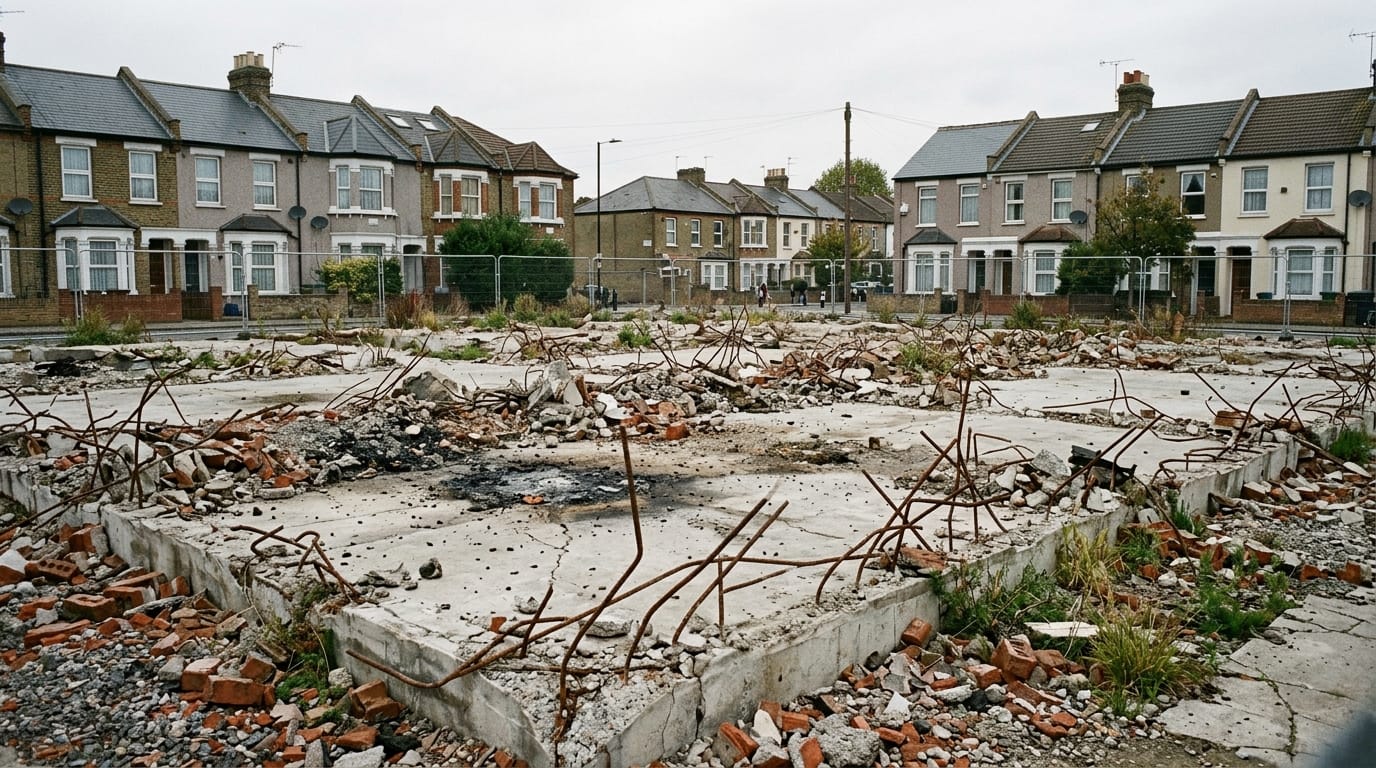
Two years ago this week, a fire tore through a seven-storey block of flats on Freshwater Road in Dagenham in the small hours of a Bank Holiday Monday. Forty fire engines and 225 firefighters tackled the blaze at the Spectrum Building. More than 80 people were evacuated and at least 20 were rescued by firefighters. The building, already wrapped in scaffolding as contractors raced to strip away dangerous cladding, was consumed so completely that it had to be demolished a few months later. What followed was not a swift resolution. It was the beginning of a legal and financial ordeal that, on the second anniversary of the fire, shows no sign of ending.
The Spectrum Building was originally an office block belonging to the American company DuPont, built in 1974 and converted to flats in 2010. In 2017, planning permission was sought to add more floors, bringing the total number of flats to 60 with a gym; the additional storeys were to be supported by a timber frame, and the application was approved following an appeal in 2018. By the time the fire broke out, the block had accumulated a troubling history. The developer was aware of safety issues, and residents had reportedly emailed the building’s management company about broken fire doors and risks about cladding on the fifth and sixth floors. In February 2022, the Spectrum Building’s residents’ association submitted written evidence to parliament as part of the post-Grenfell safety legislation process.
Their warnings went unheeded. The building was in the process of having non-compliant cladding removed at the time of the fire. The government had granted £5.9 million for remediation at the Spectrum Building through its Building Safety Fund, which was still taking place at the time of the blaze in August 2024. The full funding had been approved in July 2023, and works had started on site in December 2023. The scaffolding erected to carry out that work, intended to make the building safer, ultimately made it more dangerous. The fire grew after flaming objects were dropped onto the playground area of a private nursery on the ground floor; this ignited a timber roofing area, a rubber mulch play surface made of recycled tyres, and a plastic wheelie bin filled with cardboard, and the blaze then spread via the wind to timber planks on the scaffolding.
The Grenfell United group of survivors and bereaved families said that the Dagenham fire was “a scenario we have warned about for seven years.” The parallels were impossible to ignore. Comparisons were immediately drawn to the 2017 Grenfell Tower fire by several news outlets. Like Grenfell, the Spectrum Building had been deemed structurally sound before the interventions of later decades made it lethal.
The circumstances facing Spectrum’s leaseholders are, even by the standards of the post-Grenfell cladding scandal, extraordinarily harsh. The building is gone. The freeholder, Arinium Ltd, went into administration after the fire, with the administrators now in control of the money, including insurance proceeds. It is the administrator’s responsibility to pay these funds out to former residents to cover losses and damages caused by the fire. Two years in, that has not happened.
Sarah Williams, a charity worker who owned a flat in the building, has become one of the most prominent voices for leaseholders in limbo. She camped overnight in a car park in 2016 to put down a deposit. Her flat became unsellable when dangerous cladding was identified. Then it burned down. Residents are still paying their mortgages, and have been told the building insurance will cover the reconstruction of the block, but that this will take at least six years. Insurance is covering emergency accommodation for leaseholders for three years, but nobody knows what happens if the compensation process has not concluded by then, leaving people simultaneously liable for rent and mortgage repayments.
Williams said: “It is almost one year since the fire destroyed my flat. Unless we see urgent changes, I will face this anniversary with no home, no answers and no justice.” She has now passed the two-year mark with the position essentially unchanged. Fellow leaseholder Jesse Gill, who had moved in with his new wife just two weeks before the fire, told one broadcaster: “We haven’t been reimbursed our ground rent or service charges, and we’re having to pay our mortgage for a property that doesn’t exist.”
The financial pressures went further still. Former residents received statements from the block’s managing agent suggesting that they would have to pay for service charge deficits from 2021 and 2022, which were only calculated after the fire. One statement seen by a specialist housing publication suggested that a leaseholder faced a total bill of £1,153 for her former one-bed flat; former residents of a two-bed flat with a parking space were facing bills of up to £2,130. Some leaseholders had been paying up to £750 a month in service charges to maintain communal areas in the block, with further bills expected.
Elected representatives have grown increasingly vocal. Margaret Mullane, MP for Dagenham and Rainham, said the fire had “a devastating effect” on residents, and that she had been “deeply disappointed by the response from the building’s owner and insurer.” She added that the companies had so far refused to share information with residents, and that the fire had exposed how vulnerable residents were, not just to fire, but to being “kept in the dark” by companies that should help them.
The government’s own position has been complicated. As part of the process of formally closing the Building Safety Fund project, the Greater London Authority informed the administrators of its interest as a potential creditor in the administration, describing this as a technical, procedural step which is standard practice in insolvency law. Residents feared they were being pushed to the back of the queue. The government insisted that its position as a creditor would have no impact on the money residents are owed, and that it would only be due any funds if there were money left over after residents had been fully compensated.
The London Fire Brigade and the Building Safety Regulator are understood to still be investigating any breaches of the law in relation to the fire. The Metropolitan Police has closed its investigation into arson after finding no evidence. The cause of the fire remains officially unknown. The ongoing Health and Safety Executive probe is investigating how cladding works were organised, and whether the main accountable person had a duty to prevent fire spread, with its criminal investigation covering both its role as the Building Safety Regulator and matters under the Health and Safety at Work Act 1974 and the Building Safety Act 2022.
The Spectrum Building’s story is not unique to east London. Across the country, thousands of leaseholders remain ensnared in the cladding crisis, unable to sell, unable to remortgage, and in some cases, as here, unable to occupy the homes for which they are still legally and financially responsible. Roughly one-third of the flats in the Spectrum Block were owned by live-in leaseholders, with the rest occupied on a buy-to-let basis. The consequences fall on individuals with very different financial cushions, and the administration process does not distinguish between them.
The situation has direct relevance for buyers and owners across Norfolk and Suffolk, where leasehold flat ownership is a part of the market. Purchasers weighing up a leasehold flat anywhere in England need to understand that the protections promised after Grenfell are still, in some circumstances, works in progress. The Building Safety Act 2022 has delivered genuine progress, and the courts have reinforced it. Two significant Court of Appeal judgments have confirmed that key provisions of the Building Safety Act apply retrospectively, meaning leaseholders are protected from having to pay to fix safety issues in their building. But the Spectrum case shows that when a freeholder collapses and an administrator steps in, the process of actually converting legal protections into real money in real people’s pockets can take years.
For anyone considering a leasehold flat purchase, these are not abstract risks. The questions to ask are practical ones: who is the freeholder, what is their financial standing, has the building been assessed for cladding compliance, and what does the buildings insurance actually cover? A solicitor acting on any leasehold purchase should be scrutinising all of these points as a matter of course, not as a precaution reserved for high-rise blocks in the capital.
The second anniversary of the Spectrum fire arrives with the leaseholders no closer to certainty. The building is rubble. The freeholder is in administration. The government’s remediation funding, meant to prevent exactly this kind of catastrophe, arrived too late to stop the fire and has since become entangled in insolvency proceedings. The criminal and regulatory investigations grind on.
What has changed is the political and legal landscape around cladding more broadly. The Building Safety Act has teeth. The courts have used them. But the Spectrum case is a reminder that legislation, however well-intentioned, cannot fully protect leaseholders when the corporate structures behind their buildings can simply fold, leaving administrators to manage a queue of competing claims. Until the gap between statutory protection and practical compensation can be closed more reliably, the human cost of this crisis will continue to be measured not just in the scale of a fire, but in the monthly mortgage statements of people paying for homes that no longer exist.