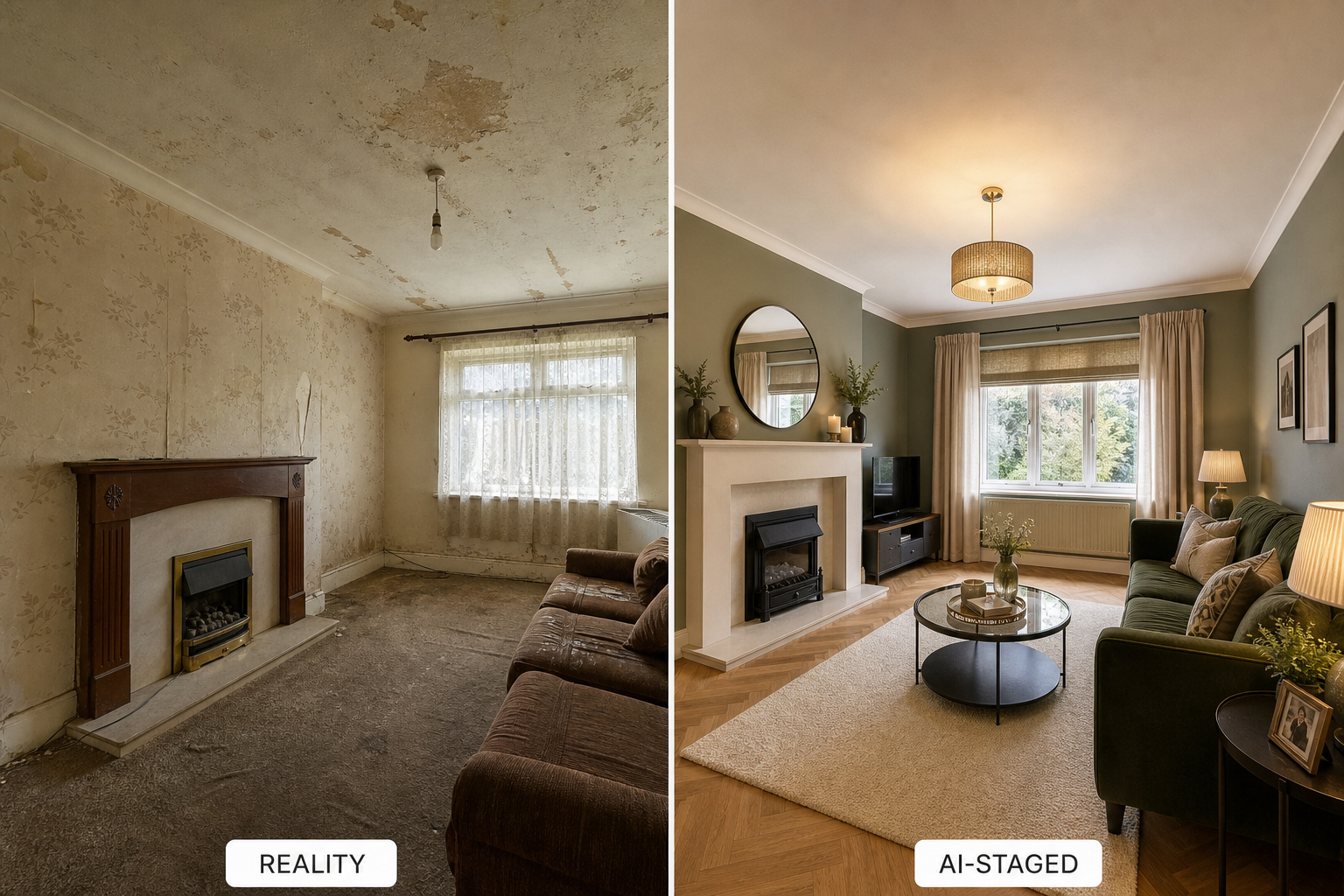
Estate agents have always presented properties in their best light. Blue skies were added to grey photos long before generative AI arrived. Wide-angle lenses made box rooms look passable. Virtual staging replaced the expensive business of renting furniture for a photoshoot. None of this was new, and none of it troubled many buyers.
What’s changed is the scale of deception now possible.
A Guardian investigation this week revealed a growing backlash against “housefishing”, the practice of using AI tools to digitally alter property listing images in ways that go well beyond cosmetic touch-ups. Walls are repainted. Gardens are extended. Chimney breasts vanish. Entire rooms are virtually staged with furniture that couldn’t physically fit through the door. One south London buyer found a property listed through Winkworth that bore so little resemblance to reality they took to Reddit to warn others. The agency removed the images and said AI staging was disclosed online to help buyers “visualise the potential of a property”.
The distinction matters. Virtual staging of an empty room with plausible furniture is one thing. Digitally removing a boiler from a wall, adding a lawn that doesn’t exist, or making a bedroom appear larger than its physical dimensions is something else entirely.
Buying agent Nina Harrison of Haringtons told the Guardian she’d recently caught a relisted property that had been so heavily reworked with AI imagery and fresh marketing copy that her client didn’t recognise it as the same house they’d already viewed and rejected. “If I hadn’t spotted it, he would have gone back to view the same house for a second time,” she said.
Another buyer drove 75 minutes from south Wimbledon to Maidenhead to view a house listed at £635,000. The main bedroom had been AI-staged with a large bed, bedside tables and a wardrobe. In person, none of that furniture would have fitted alongside a bed. The couple didn’t confront the agent. They still needed help finding a property. But the experience made them instinctively suspicious of any listing with “even a whiff of AI about it”.
Property photography wasn’t always so polished. In the 1990s, agents took their own photos and rushed film to the high-street processor. A maximum of three images made it into a printed brochure. The launch of Rightmove in 2000 changed everything, professionalising property imagery and creating an arms race for visual impact that hasn’t slowed since.
Ben Gutierrez, who founded property photography agency Photoplan Bookings in 2002, draws a clear line. “We’ve always added blue skies to photos, we’ve always brightened images, we’ve always used wide-angle lenses, we’ll take out a bin here or there,” he told the Guardian. “We’re making the property look the best it can, not altering reality.”
Doncaster-based photographer Ben Harrison goes further: “I’ve been asked to remove a load of houses behind a property so that it looks like it’s on its own on a mountain. I’ve been asked to erase an electricity pylon. I say no every time. People are going to view the properties and they’re going to see the other houses, or the pylon, or the boiler.”
The Property Misdescriptions Act 1991 was repealed in 2013, but real estate listings now fall under the Digital Markets, Competition and Consumer Act and existing consumer protection regulations. Materially misleading images can constitute a breach, though enforcement remains patchy. The Advertising Standards Authority has ruled on specific cases, but the pace of AI adoption has outstripped the regulatory response.
For buyers in Norwich, Wymondham or Ipswich, the practical advice is straightforward: treat listing photos as marketing material, not documentary evidence. Cross-reference floor plans with room dimensions. Use satellite imagery to check garden sizes. And if a property looks suspiciously perfect online, trust your instincts.
The housefishing trend isn’t confined to London and the Home Counties. As AI image tools become cheaper and more accessible, agents of all sizes can deploy them with minimal cost or expertise. Rural and coastal properties are particularly susceptible to enhancement. It’s easy to imagine a tired cottage near Great Yarmouth or a dated bungalow outside King’s Lynn receiving the AI treatment to compete in an increasingly visual online marketplace.
The Ivybridge Collection’s property market reports across 324 locations provide buyers with independent data on local pricing, recent transactions and market conditions, a useful counterweight to the glossy impression created by listing photos alone.
The deeper issue isn’t technology. It’s trust. Estate agency has always involved salesmanship, and buyers have always understood that. But there’s a social contract at work. When a buyer drives an hour to view a property that bears no resemblance to its listing, the contract is broken. The agent hasn’t just wasted the buyer’s time. They’ve damaged their own credibility and, by extension, the profession’s.
Smart agents already understand this. Professional photography, honest staging and accurate descriptions don’t just serve buyers. They produce better-qualified viewings, fewer complaints and faster sales. AI can be a legitimate tool when used to declutter or present an empty space with plausible furniture, clearly disclosed. The problems start when agents use it to hide defects, inflate dimensions or fabricate features.
The industry will likely self-correct to some degree. Rightmove and Zoopla could introduce mandatory AI disclosure labels, much as social media platforms now flag AI-generated content. Professional photography associations are developing guidelines. And buyers themselves are becoming more sophisticated at spotting fakes.
But the gap between what’s technically possible and what’s ethically acceptable will keep widening. Agents who treat AI as a tool for honest presentation, rather than digital deceit, won’t just stay on the right side of the law. They’ll build the kind of trust that actually sells houses.