
When most homeowners choose an estate agent, they compare fees. The agent charging 1% gets a harder look than the one charging 1.5%. The logic seems sound: why pay more for what appears to be the same service?
But for sellers of significant homes, this logic is not just flawed. It is expensive.
Because the real cost of choosing the wrong agent is never the fee. It is the outcome.
Consider a home worth £1.5 million.
Agent A charges 1% and achieves an asking price sale: £1.5 million. Fee: £15,000. Net to seller: £1,485,000.
Agent B charges 1.5% but, through better positioning and stronger negotiation, achieves 3% above asking: £1,545,000. Fee: £23,175. Net to seller: £1,521,825.
Agent B cost £8,175 more in fees but delivered £36,825 more to the seller.
Now consider the reverse scenario, which is far more common.
Agent C charges 1% but overprices the property, leading to 150 days on market, two price reductions, and an eventual sale at 5% below the realistic market value: £1,425,000. Fee: £14,250. Net to seller: £1,410,750.
The difference between the best and worst outcome in this example is over £111,000. The fee difference between the cheapest and most expensive agent is £8,175.
The fee is a rounding error compared to the outcome.
The wrong agent does not cost you money through their fee. They cost you money through a series of errors that compound over time.
The most expensive mistake in property is the wrong asking price. Too high and the property sits. Too low and you leave money on the table.
Most agents arrive at a price through basic comparable analysis, adjusted by instinct and the desire to win the instruction. Many will suggest a higher price than they believe the market will bear, knowing that the seller will choose the agent who values their home highest.
This is the valuation trap. The agent who tells you what you want to hear wins the instruction. The agent who tells you the truth often does not. But three months later, when the overpriced property has not sold and the first reduction is being discussed, the truth has a way of reasserting itself.
The cost of this pattern is not just the final sale price. It is the time, the stress, and the market perception that shifts every day a property remains unsold.
At the premium end, presentation is not a nice-to-have. It is the single biggest factor in whether a buyer books a viewing.
A buyer scrolling through Rightmove at £1 million and above has expectations. If the photography looks like it was taken on a phone, they scroll past. If the description reads like a spec sheet, they scroll past. If the first three images show a hallway, a bathroom, and a utility room, they scroll past.
They do not come back. There is no second chance at a first impression on a property portal.
The difference between professional property marketing and standard property marketing is not cosmetic. It is financial. A home that attracts 20 qualified viewings will sell for more than a home that attracts 5. A home that creates emotional connection through its imagery and narrative will attract better offers than one that lists its rooms.
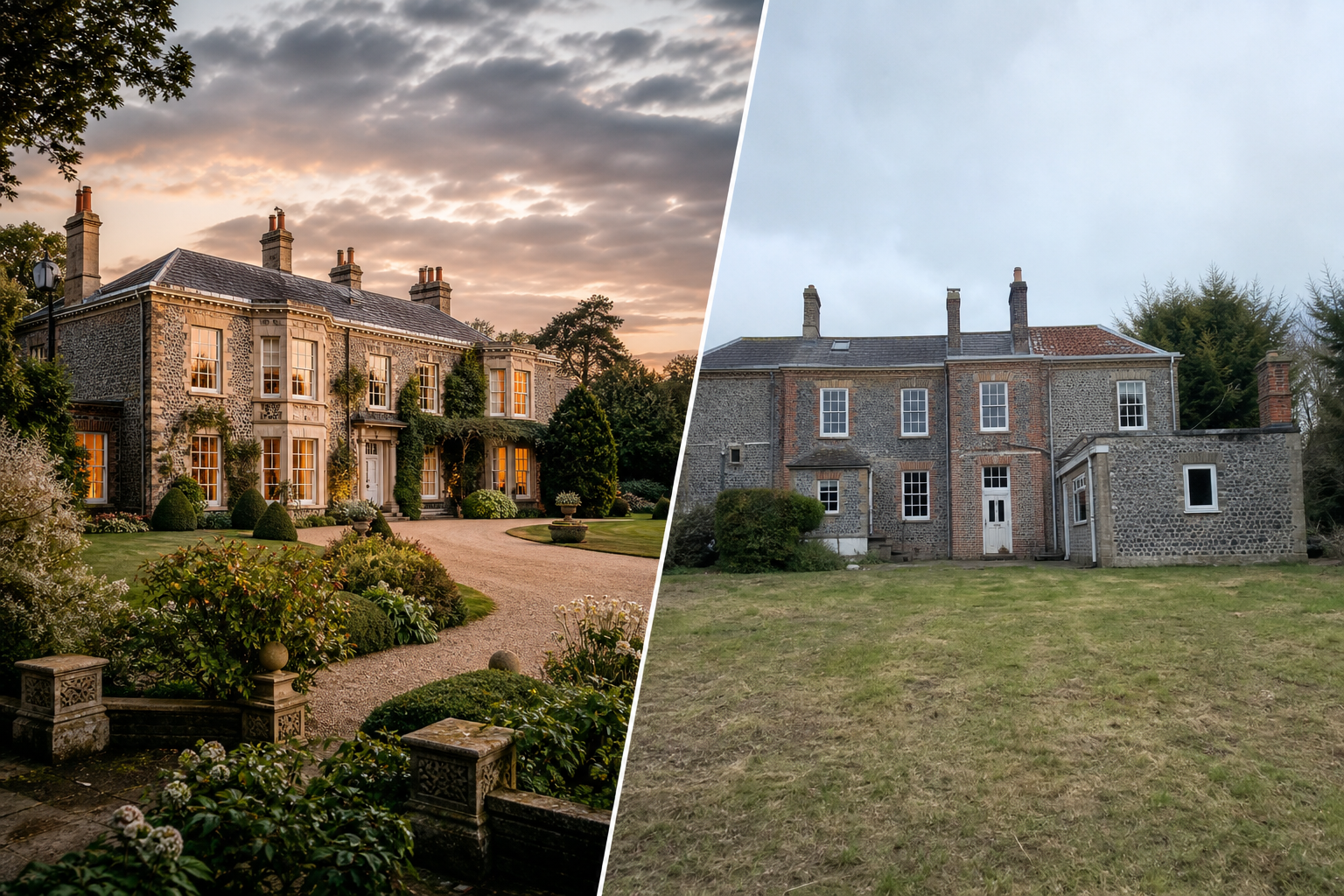
We see this constantly. Our case study of Mill Farm Barn is a clear example: a home that sat on the market for over a year with no viewings under a previous agent, sold in 11 days after we relaunched it at the same price with completely different marketing. The home did not change. The agent did.
Negotiation at the premium level is not about haggling. It is about understanding buyer psychology, managing competing interest, and knowing when to hold firm.
An inexperienced negotiator accepts the first offer because they are afraid of losing it. A skilled negotiator understands that a buyer who has fallen in love with a home at their viewing will not walk away over a measured counter-offer.
The difference between these two approaches on a £1.2 million property can easily be £30,000 to £60,000. That is not a theoretical number. That is the gap between an agent who manages the process and an agent who simply facilitates it.
Over 30% of property sales in England and Wales fall through after an offer is accepted. At the premium end, the consequences are amplified: smaller buyer pools, higher sunk costs, and greater market stigma when a property returns to the market.
An agent who does not actively progress the sale, who does not chase solicitors, manage surveys, coordinate chains, and maintain buyer confidence through the legal process, dramatically increases the risk of collapse.
The cost of a collapsed sale on a £1 million home is not just the £5,000 to £10,000 in wasted legal fees. It is the 3 to 6 months of lost time and the lower price you will almost certainly achieve when the property relaunches.
Choosing an agent based on fee is like choosing a surgeon based on price. The fee is the least important variable in the equation.
What matters is the outcome. And the outcome is determined by pricing accuracy, marketing quality, negotiation skill, and post-offer management.
A good agent at 1.5% who achieves full asking price is cheaper than a bad agent at 0.75% who achieves 5% below. The maths is straightforward. The emotional difficulty is accepting that the cheapest option is often the most expensive decision.
When you are choosing an agent for a significant home, the questions that determine your outcome are not about fee percentages. They are about process.
How will you determine the right asking price? Not “what is the property worth?” but “what analysis will you do to arrive at that figure?”
What does your marketing include? Not the list of portals, but the actual creative process. Who takes the photographs? Who writes the copy? How long does the process take?
How many homes do you handle at once? An agent managing 80 properties cannot give your home the same attention as one managing 8.
What happens after an offer is accepted? If the answer is vague, the risk of collapse is high.
What protection do you offer against a buyer pulling out? If the answer is none, ask why.
These questions will tell you more about the likely outcome than any fee comparison ever could.
A 5% underperformance on a £1.5 million home is £75,000. On a £2 million home, it is £100,000.
A collapsed sale costs £5,000 to £10,000 in wasted fees plus 3 to 6 months of time plus a likely price reduction on relaunch.
Poor photography and presentation on a premium listing can mean the difference between 3 viewings and 30.
The wrong pricing strategy can add 6 to 12 months to a sale and reduce the final price by 5% to 10%.
Add those up and the “expensive” agent starts to look like the bargain.
If you are preparing to sell a significant home in Norfolk or Suffolk and want to understand what the right approach looks like, request a Property Pricing Brief or call us on 01603 369977.