

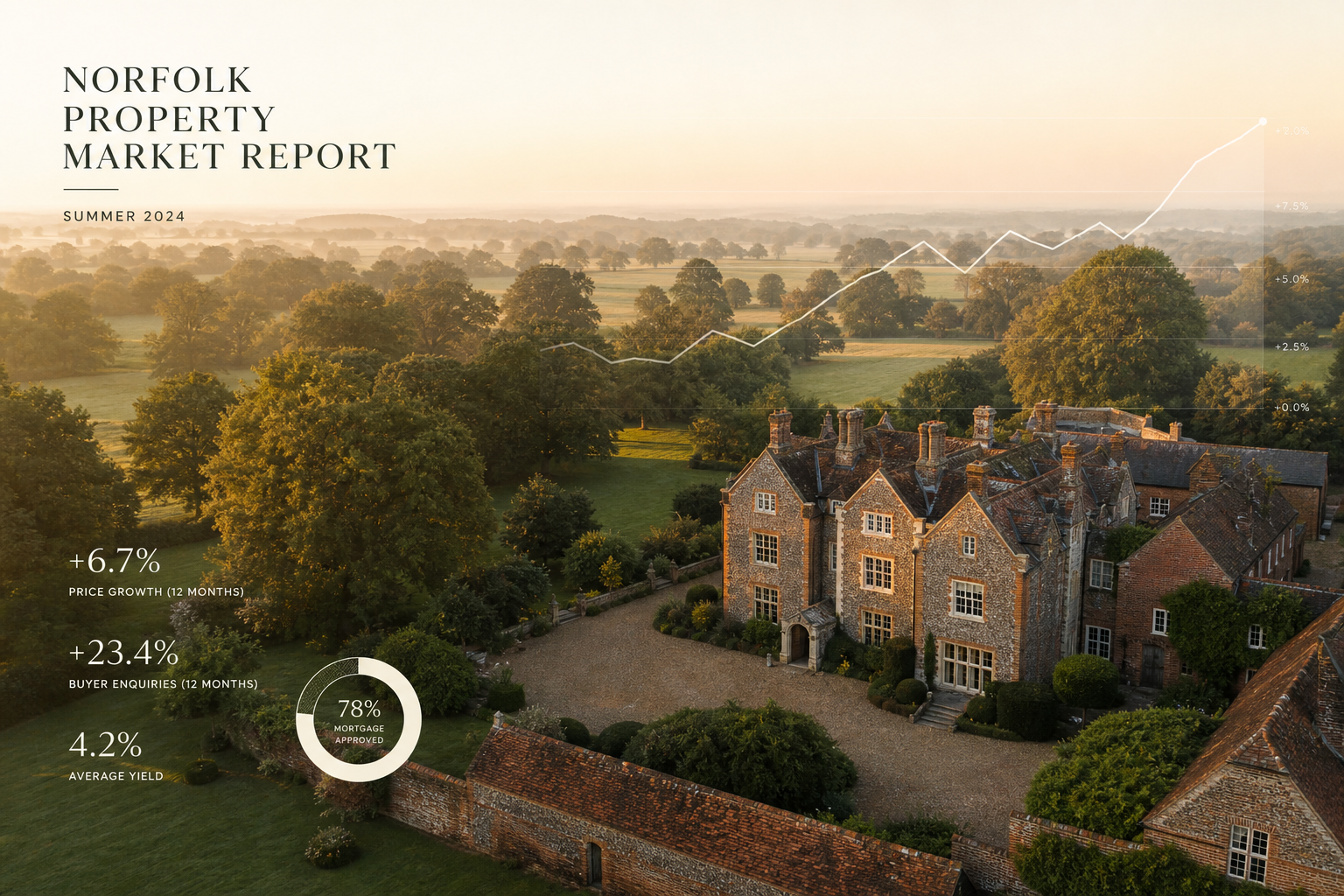
This week’s market data paints a picture of resilience. Zoopla’s April House Price Index confirms annual house price growth of 1.3% nationally, with enough transactions completing to keep values stable. Buyer enquiries have fallen 13% compared to this time last year, yet sales agreed are only 2% below the same period. In plain terms: fewer people are looking, but those who are looking are buying. Well-priced homes are still selling in comparable timeframes to twelve months ago.
The divergence between falling enquiries and relatively steady completions is the story of May 2026. It reflects a market shaped by necessity as much as desire. Sellers are moving because circumstances demand it. Buyers who remain active are decisive.
The average two-year fixed mortgage rate now stands at 5.81%, up from 4.83% at the start of March. The average five-year fix has risen to 5.70%, from 4.95% over the same period. This sharp upward movement is largely a consequence of the Middle East conflict that began in late February, which triggered inflationary pressure and prompted markets to reprice rate expectations.
The Bank of England held its base rate at 3.75% on 30 April, voting 8-1, with one member actually calling for an increase to 4%. Markets are now pricing in the possibility that the base rate could reach 4.5% by the end of 2026. The next MPC decision is 18 June. For buyers with access to meaningful deposits, best-buy deals tell a different story: HSBC is currently offering 4.45% on a two-year fix at 60% LTV.
The practical implication is straightforward. Buyers waiting for rates to fall to the levels seen in January 2026 may be waiting a long time. For those with strong equity positions, acting now at a competitive rate is arguably more predictable than holding out for a market move that may not arrive this year.
Nationwide’s April data recorded a 0.4% monthly rise and 3.0% annual growth, with average prices at £278,880. Halifax recorded a small 0.1% monthly dip but annual growth of 0.4%, with an average of £299,313. The Land Registry, which tracks completed sales rather than asking prices, shows February prices up 1.2% year-on-year at £267,957.
Rightmove’s May asking price data recorded average new-to-market prices at £378,304, up 1.2% on the month. Stocks available to buyers are at their highest May level since 2015. There is choice in the market. That is precisely why presentation and pricing discipline matter so much right now: a well-presented, accurately priced home stands out sharply against a backdrop of greater supply.
Norfolk’s property landscape in 2026 is increasingly telling two distinct stories. In the commuter-friendly suburbs and market towns ringing Norwich, demand is holding firm and values are edging upward. The Norwich fringe, Broadland villages and well-connected towns like Wymondham and Reepham continue to attract buyers seeking character, good schools and manageable commutes.
Along the North Norfolk coast, a more nuanced picture is emerging. A combination of second-home tax reforms and stretched affordability has softened asking prices in some of the county’s most sought-after coastal communities. For buyers with long-term ambitions in coastal Norfolk, this represents a considered moment to look seriously.
County-wide data shows 18,647 active listings, with an average asking price of £337,935 and a median of £285,000. Detached homes average £458,141, with a median of £399,995. The average time on market across all property types is 226 days, with the median at 207 days. At the premium end, the 314 properties priced above £1 million are averaging 262 days on market. That figure is not a warning sign: it is an accurate reflection of a discerning buyer pool taking appropriate time over life-changing decisions.
The RICS April Residential Market Survey, published on 14 May, reflects the macro uncertainty that has characterised the spring. Buyer enquiries and agreed sales volumes have both been affected by the combination of higher mortgage rates and geopolitical caution. New instructions are holding up, and surveyors note that sensibly priced stock in desirable locations continues to attract interest. The survey’s twelve-month price expectations remain positive, with a net balance of respondents expecting values to be higher a year from now.
The takeaway from RICS is not pessimism. It is a reminder that pricing realism from the outset is not compromise. It is strategy.
There are more buyers active in the Norfolk market than the headline enquiry figures suggest. Many are pre-qualified, motivated and operating within a defined budget shaped by today’s mortgage environment. Reaching them requires clarity: clear pricing, exceptional presentation, and marketing that speaks to the life a home enables rather than just the rooms it contains.
Properties being marketed with professional photography, lifestyle-led copy and targeted digital reach continue to attract competitive interest. Those sitting on the market without a fresh approach are accruing days-on-market figures that become a negotiating tool for buyers. If your home has been listed for more than three months without meaningful progress, the question is not whether to reduce the price. The question is whether the marketing is working as hard as the property deserves.
The supply picture is the most favourable it has been since 2015 at this point in the year. Buyers have more choice than at any point in the past decade in May. That does not mean procrastination is rewarded. Well-priced homes in prime Norfolk locations, particularly those combining character, land and good connectivity, continue to attract multiple parties when they come to market correctly.
Buyers who have secured a mortgage in principle and defined their search criteria are in a strong position. The North Norfolk coastal market in particular merits a fresh look. Where asking prices have softened, the opportunity cost of waiting is measured against a rate environment that may not improve materially before year-end.
The next Bank of England MPC decision falls on 18 June. Markets currently expect the base rate to be held again at 3.75%, though a minority case for a further increase remains on the table given CPI at 2.8% and the inflation expectations embedded in geopolitical risk.
The RICS May survey is due on 11 June. Rightmove’s June HPI will be published around the 18th. For Norfolk, the key local indicators to watch are the velocity of new instructions through the spring and any movement in coastal asking prices as the summer season approaches.
The market is not quiet. It is considered. Sellers who match that energy with precision, and buyers who move with conviction, are the ones completing transactions this spring.