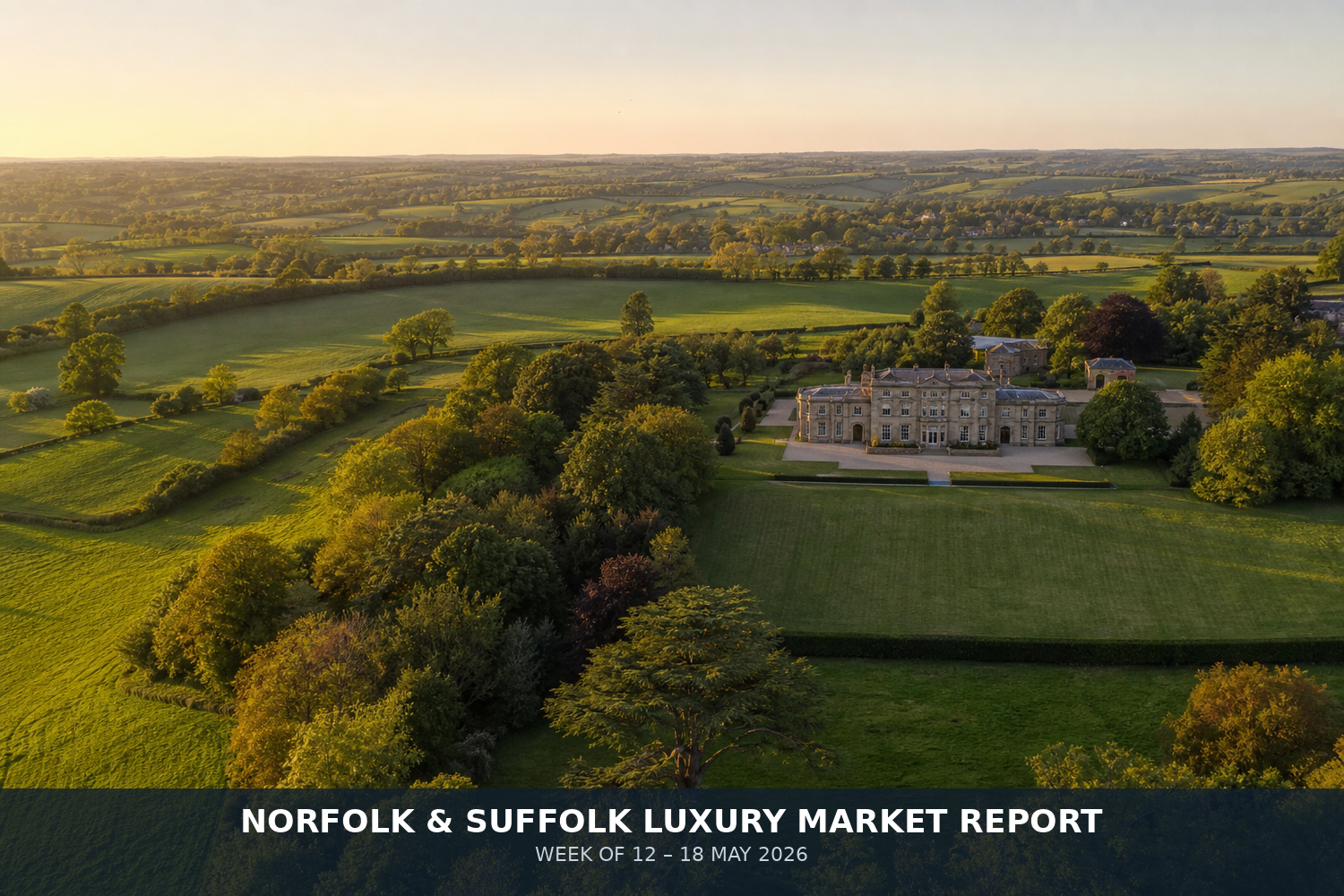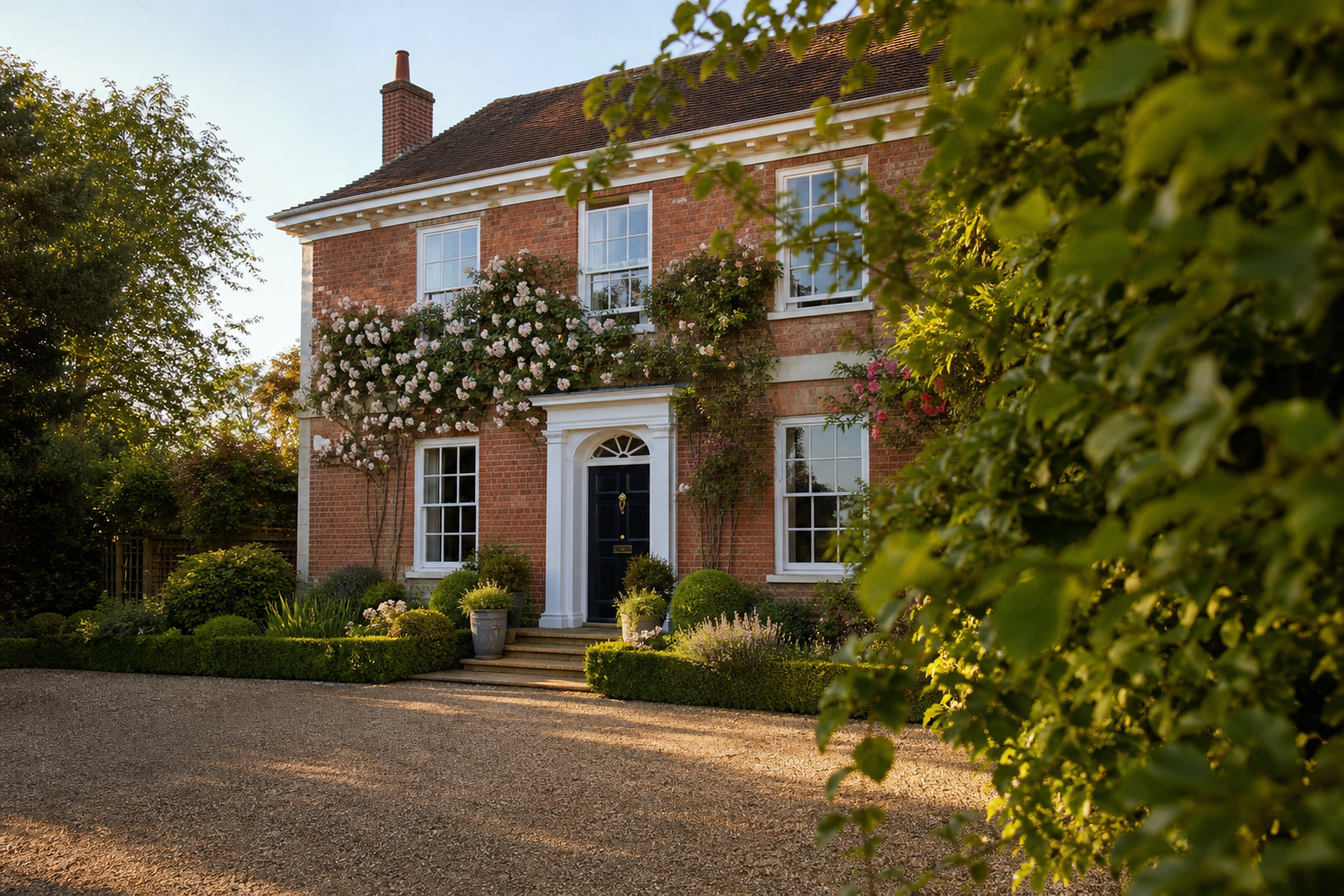

The UK housing market moved into May with more confidence than many had anticipated. Rightmove’s House Price Index, published on 18 May, recorded average asking prices rising 1.2% month-on-month to £378,304. That seasonal uplift is above the ten-year average for May of 1.0%, and it signals that committed buyers and sellers are pressing ahead despite the wider economic backdrop.
For the Norfolk market specifically, buyers at every price point need to understand what is driving prices, what is dampening them, and where the genuine opportunities sit this week. Here is the picture as of 21 May 2026.
The most important thing to understand about the current market is that it is not behaving as a single, unified national story. Rightmove’s data shows a clear regional split: the North East is up 2.7% year-on-year and the North West up 2.6%, while London is down 2.4% and the South East is down 1.6% over the same period.
East Anglia, including Norfolk and Suffolk, sits in an interesting middle ground. The region benefits from lifestyle-driven demand that insulates it from the steeper falls seen in the capital, while not sharing the affordability-driven momentum of the north. For premium Norfolk property in particular, this creates a nuanced picture where quality and correct pricing continue to define outcomes.
The Bank of England held its base rate at 3.75% at the Monetary Policy Committee meeting on 30 April 2026, the second consecutive hold. The vote was 8 to 1 in favour of no change, with one member preferring an increase to 4.0%. The next MPC decision is scheduled for 18 June 2026.
Mortgage rates have moved marginally in buyers’ favour this month. Rightmove’s daily tracker recorded the average two-year fixed rate at 5.18%, down from 5.42% last month. The average five-year fix currently sits at approximately 5.70% according to Moneyfacts data, compared with 5.78% a month ago. On a 30-year repayment mortgage of £200,000, the typical monthly payment at the leading five-year fixed deals available this week is around £996.
The best five-year fixed rates from major lenders are currently available from Nationwide at 4.40% and Halifax at 4.42%, both at 60% loan-to-value. For buyers with larger deposits, the competitive end of the market is meaningfully better than the averages suggest.
The Halifax House Price Index shows the average UK house price fell 0.1% between March and April to £299,313, with annual growth of 0.4%. Nationwide’s index paints a marginally more positive picture, recording a 0.4% monthly increase in April taking the average to £278,880, with annual growth of 3.0%. The gap between the two indices reflects different methodologies rather than contradictory market conditions.
The Fine and Country Residential Sales Market Report for May 2026 noted that transactions rose 1% in March to 104,070, the highest seasonally adjusted monthly total since March 2025. Mortgage approvals reached 63,531 in March, up 1.3% from February and the highest since November 2025. Both figures point to underlying market resilience rather than deterioration.
The April 2026 RICS UK Residential Market Survey, published on 14 May, painted a more cautious picture. A net balance of -34% of respondents recorded a fall in new buyer enquiries, and the agreed sales balance came in at -36%. These are not figures to dismiss, but they reflect the weight of higher borrowing costs rather than a structural break in demand.
Crucially, the twelve-month outlook for prices remains in positive territory for most RICS respondents, and the survey noted that near-term expectations, while subdued, showed some stabilisation. The May survey results will be published on 11 June and will give a clearer read on whether the spring market has found a floor.
Current data from property tracking platforms shows 18,647 active listings across Norfolk as of mid-May, with an average asking price of £337,935 and a median of £285,000. The average time on market sits at 226 days across all property types, with detached homes averaging 222 days and flats at 248 days.
In the premium segment that defines Ivybridge Collection territory, 314 Norfolk properties are currently listed at over £1 million, representing 2% of total stock. Average days on market for properties priced at £1 million and above is approximately 262 days, reflecting the longer decision cycles typical of high-value transactions.
Detached homes across Norfolk average £458,141 at asking price, with five-bedroom and larger properties averaging £697,263. At the very top of the market, the picture continues to be defined by selectivity: buyers are present and motivated, but they are scrutinising value carefully and moving decisively when they find it.
Coastal and market town locations continue to command a premium over the county average. Villages with strong road and rail links to Norwich, and coastal communities within the AONB, remain the most actively competed segments at the higher price points.
The most important variable in achieving a sale in today’s market is pricing accuracy at launch. Rightmove’s May data confirms that 32% of all listings nationally have seen at least one price reduction, and properties with reductions typically spend significantly longer on market. Over-ambitious pricing is not a negotiating strategy in May 2026, it is a delay mechanism.
For Norfolk sellers at the premium end, the supply position is worth understanding. Buyer choice is at its highest level for this time of year since 2015 nationally, meaning that well-presented, correctly-priced homes stand out more clearly but face more competition from other sellers than in recent years. The presentation of your home and the quality of its marketing have rarely mattered more.
The holding of the base rate at 3.75% provides a degree of stability for pricing conversations. With no imminent cut signalled before June at the earliest, this is a market where sellers benefit from positioning their home against what buyers can realistically afford rather than speculating on future rate movements.
The slight improvement in mortgage rates this month is a genuine, if modest, positive. A fall of 0.24 percentage points in the average two-year fix reduces monthly payments by approximately £50 on a typical mortgage. That is meaningful to many buyers, even if the headline rates remain well above the lows of 2021 and 2022.
The current high level of stock on market gives buyers genuine choice, and that choice is forcing sellers to price competitively. For buyers who have been waiting on the sidelines anticipating further rate cuts, the risk is that the properties they want are not guaranteed to still be available when the rate environment improves. Motivated sellers are moving now, and the buyers who engage seriously are finding they have more leverage in negotiations than at any point in the past three years.
For buyers financing above 60% LTV, the mortgage market still requires careful navigation. Lenders are competing actively for business in 2026, and the difference between the best and the average deal can be several hundred pounds per month. Independent mortgage advice has rarely been better value.
The Bank of England’s next MPC decision is on 18 June. Between now and then, the key data releases to watch are the May inflation figures and the April labour market update. If inflation continues to edge down towards the 2% target, market expectations for a June cut may solidify, which would provide a further, modest boost to buyer confidence.
Rightmove’s next House Price Index is scheduled for mid-June and will capture new listings from mid-May to early June, giving the first detailed read on whether the spring market activity has translated into sustained asking price confidence. We will also be watching the RICS May survey on 11 June for any change in the sentiment trajectory.
For Norfolk specifically, the school holiday period beginning in late July typically brings a softening in new listing volumes, meaning that the next six to eight weeks represent the most active window of the spring-summer market. Both buyers and sellers operating in this window generally benefit from making decisions promptly.
If you are considering a sale in Norfolk or Suffolk and would like to understand how current market conditions affect your property specifically, speak with The Ivybridge Collection. We are available on 01603 369977 or at [email protected].
You don't need to be ready to sell to speak with us. We have quiet, confidential conversations with homeowners across Norfolk and Suffolk every week. About timing, about value, about what the market looks like right now. No obligation. No pressure. Just an honest conversation.
Some owners choose to commission a Strategic Property Report before bringing their home to the market, allowing pricing, positioning and preparation to be considered privately.