Keir Starmer has resigned. He is the sixth Prime Minister to leave office in under a decade. The headlines will run for days. History suggests the housing market is far more sensitive to borrowing costs than to changes of Prime Minister.
Look at the numbers and you will see why.
Since March alone, the average two-year fixed mortgage rate has climbed from 4.83% to 5.68%. For a typical buyer, that shift in borrowing power matters far more than a change of Prime Minister.
The cost of borrowing has consistently mattered more than the name on the door of Number 10. The evidence from the past decade supports that view clearly.
We have the data from four recent departures: Boris Johnson, Liz Truss, Theresa May, and now Starmer. Recent periods of political turbulence have tended to create a short pause in activity before the market refocuses on borrowing costs, affordability and supply. Mortgage approvals typically dip for a few weeks, new buyer registrations pause, sellers delay listing, and then activity returns to whatever trajectory the fundamentals were already dictating.
When Theresa May resigned in June 2019, sub-2% five-year fixes cushioned the impact. When Liz Truss departed, demand collapsed, but that was the mini-Budget repricing borrowing costs overnight, not the resignation itself. The political event was the trigger, not the cause.
The critical question after every leadership change is the same: what happens to the cost of money? And this time the answer is more complicated than usual.
The Bank of England held the base rate at 3.75% on 18 June. The vote was 7-2. Two members voted to raise rates, not cut them. Pay attention to that.
These are facts. The Iran conflict, now into its fourth month, has contributed to mortgage rates sitting at 5.68% rather than the sub-4.5% most forecasters expected by now. Rising energy prices feed inflation. Elevated inflation keeps the Bank of England on hold, or, as two of its members argued last week, makes the case for going the other way entirely.
UK 10-year gilt yields stand at 4.75%. Thirty-year gilts are at 5.38%. Swap rates, the instruments that directly price the fixed-rate mortgage on your kitchen table, sit at 3.43% for two-year terms and 3.56% for five.
This is interpretation. A change of Prime Minister introduces uncertainty, and bond markets charge for uncertainty. If gilt yields push above 5%, mortgage rates are likely to follow. The real question for homeowners is not who enters Downing Street, but what the bond market thinks of them when they get there.
The bigger question is not who enters Downing Street, but whether inflation pressures continue to keep gilt yields and swap rates elevated. The Iran conflict, energy prices, US interest rates, UK wage growth, and fiscal policy all feed into that equation. Any one of them could matter more than the resignation itself.
Andy Burnham is widely expected to succeed Starmer. His housing policy positions deserve scrutiny, though it is important to distinguish between policy proposals and government policy.
Burnham has previously expressed support for proposals that would replace stamp duty and council tax with a single annual property charge based on a home’s value, approximately 0.48% paid every year. This is not government policy. It is not even official Labour policy. It is a position associated with him. But markets often move on expectation rather than legislation, which is why it warrants attention now.
If such a policy were implemented, the numbers would look something like this. On a home worth £500,000, stamp duty currently costs the buyer £12,500 upfront. Under this model, that drops to zero, replaced by roughly £2,400 a year. On a £1 million home, the upfront cost falls from £41,250 to nothing, replaced by an annual charge of approximately £4,800.
For sellers, this could potentially unlock an entire segment of buyers currently frozen by transaction costs. Stamp duty is the single largest friction in the housing market, and removing it would represent one of the most significant structural changes to property taxation in decades.
The other side is unavoidable. Every homeowner would pay, every year, whether they moved or not. A home worth £2 million would attract roughly £9,600 a year, a permanent annual bill that does not currently exist.
Burnham’s other positions reinforce the direction of travel: a proposed £40 billion borrowing programme for council housing, suspension of Right to Buy on new builds, stronger enforcement against substandard landlords under a Good Landlord Charter already tested in Greater Manchester, and continued support for the Renters’ Rights Act.
Whether any of this is implemented in full remains to be seen. The point is that the policy landscape could shift significantly, and sellers and buyers should be aware of the possibilities.
Political uncertainty has often coincided with increased interest from London buyers looking beyond the South East, a trend Norfolk has benefited from repeatedly.
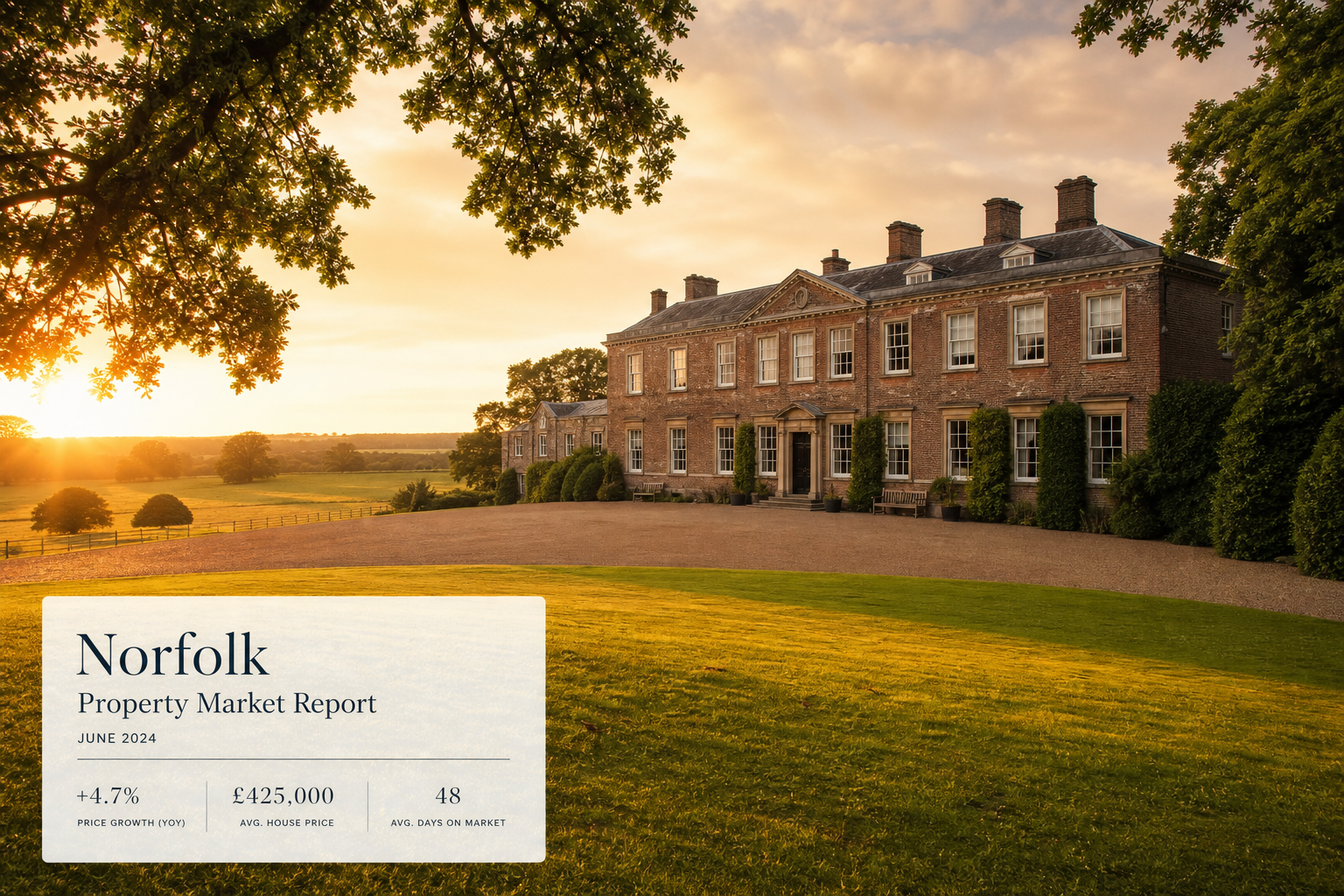
The data we can point to: London prices are down 2.1% year-on-year. The South East has recorded consecutive falls. Norfolk, meanwhile, holds broadly steady at an average asking price of £337,935 across 18,647 listed homes.
These are typically professionals with substantial equity who have been weighing up a move for months, sometimes years. Whether political disruption accelerates those decisions is difficult to prove with certainty, but the pattern of enquiry volumes from London postcodes has been consistent through previous transitions.
Norfolk offers mainline access to London, a quality of life the South East struggles to replicate, and a value proposition that sharpens with each quarter of London weakness. That combination continues to attract interest, regardless of who occupies Number 10.
Governments change frequently. Housing supply changes painfully slowly.
Britain still builds fewer homes than most analysts believe it needs. Planning constraints, construction costs, labour shortages, and local opposition all contribute to a chronic undersupply that has persisted through six Prime Ministers and counting.
This is one reason prices have remained surprisingly resilient despite repeated political upheaval. Demand fluctuates with borrowing costs, confidence, and employment. Supply barely moves at all. That imbalance is more important to the long-term direction of the market than any single change of government.
Across our 324 monitored property markets in Norfolk and Suffolk, 79% currently favour buyers. The average SSTC rate stands at 20%, meaning more than four in five listed properties have yet to find a buyer.
These are facts: Rightmove’s June data shows asking prices down 0.6% nationally, the largest June fall in fourteen years. Buyer demand is off 10% year-on-year. Nationwide and Halifax have both recorded consecutive monthly price falls.
This is what we observe: Properties are still selling. The market has become more selective. Correctly priced, well-presented homes are transacting within weeks. The gap between selling quickly and sitting for months comes down almost entirely to how a property is positioned when it first goes to market.
In the premium segment above £1 million, 314 properties are currently listed across Norfolk with an average of 262 days on market. The buyer pool at this level is specific and patient. When the right home appears at the right price, decisions tend to follow quickly. Our experience suggests political headlines are rarely the determining factor at this level.
If you are selling, the fundamentals of your property have not changed. What may change is the window. If gilt yields respond to the political transition by rising, mortgage products will be repriced and buyers who can proceed today may have more purchasing power than those who wait until September. The sellers who tend to do well in this environment are the ones who are already priced correctly, presented properly, and marketed to the right audience.
If you are buying, political transitions have historically offered some of the better negotiating conditions of any given year. Activity tends to pause, competition eases, and motivated sellers become more flexible. If you have a mortgage rate locked in, there is a strong argument for protecting it. If you are still arranging finance, there may be a stronger case than there was a week ago for getting on with it.
Britain’s property market has now outlasted more Prime Ministers than most people have had mortgages. Anyone still waiting for political certainty before making a move is waiting for something that has not existed since 2016.
The people who have navigated this market well are the ones who made decisions based on what they could measure: the cost of borrowing, the depth of local demand, the quality of the home, and the honesty of its pricing. Those fundamentals have not changed. They are unlikely to change because of a press conference on the steps of Downing Street.
The question worth asking today is not who the next Prime Minister will be, but whether your property is positioned for the buyers who are active right now.