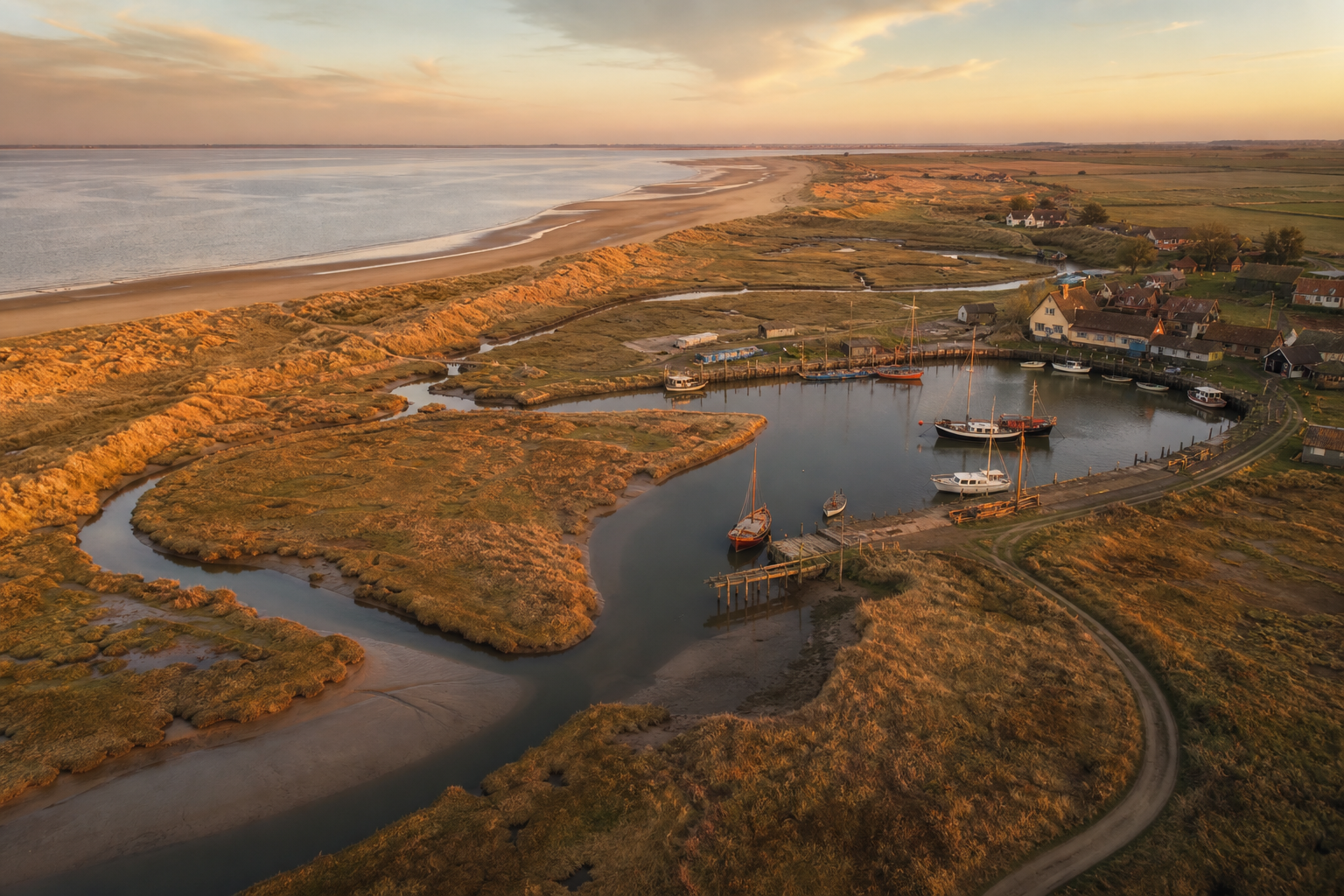
There is a stretch of the North Norfolk coast that operates by different rules. Between the salt marshes of Burnham Deepdale and the dune-backed National Trust beach at Brancaster, property changes hands at prices that sit far above the county average, driven not by commuter demand or local economics but by something harder to quantify: the feeling of the place itself.
This guide covers the Burnham Coast, from Burnham Market at its heart to Brancaster, Brancaster Staithe, Burnham Overy Staithe, Burnham Deepdale and Holkham. It sets out what properties cost, who is buying, and what sellers need to understand about this distinctive and resilient market.
This sliver of North Norfolk, running along the A149 between Wells-next-the-Sea and Hunstanton, has attracted a particular type of buyer for generations. The combination of vast beaches, protected landscape, elite schooling connections and a village infrastructure that would embarrass many market towns has made it one of England’s most sought-after rural destinations.
Property here is not primarily driven by affordability or value growth calculations. It is driven by lifestyle, heritage and a scarcity that is genuinely structural: the coast is flanked by AONB designation, National Trust ownership and the Holkham Estate, so new supply is minimal. What does come to market tends to attract serious, motivated buyers.
The North Norfolk district average sits at around £289,000 (ONS, December 2025). Along this coastal corridor, averages run at two to three times that figure. The gap is not an anomaly; it is the long-term premium for one of England’s most protected and distinctive coastlines.
Burnham Market has been called Chelsea-on-Sea, and while the nickname slightly undersells it, the comparison captures something real. The village green, flanked by independent delis, boutiques, galleries and estate agents, creates a scene that is genuinely hard to find elsewhere in rural England. The village is effectively a working high street for the affluent, served by good food, quality schools and a community that functions year-round rather than just in summer.
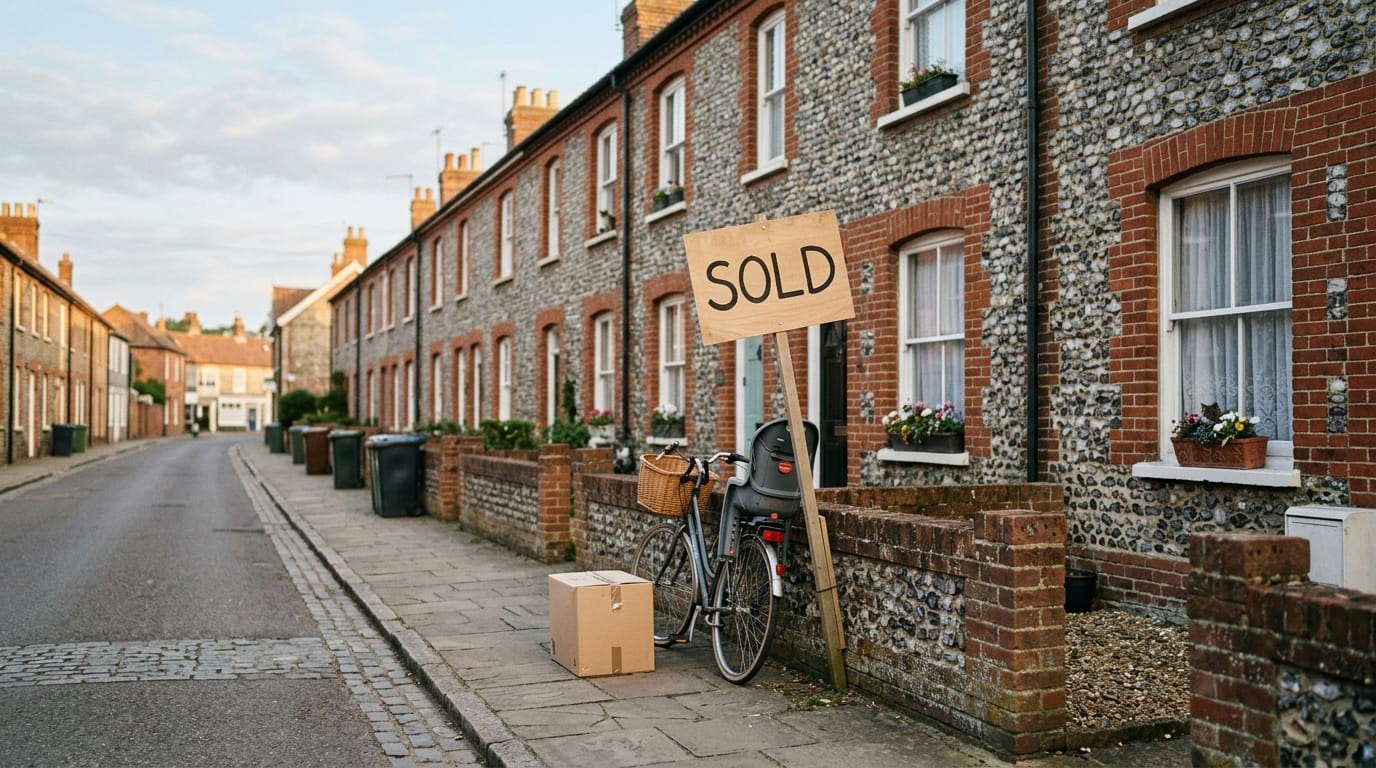
Prices reflect its status. The average property in Burnham Market now sits at around £625,000, with homes fronting or overlooking the green regularly trading above £1 million (Norfolk Living Guide, 2026). A strong supply of period flint cottages, Georgian townhouses and converted barns underpins the stock; modernised examples in the best positions command significant premiums.
Around one in four properties in the village is a second or holiday home, a figure that has prompted local planning debate in recent years. For sellers, that means a buyer pool that is largely discretionary and unhurried, but financially capable and often well-prepared. They tend to know the area and know what they want.
Three miles west of Burnham Market, Brancaster and its harbour twin Brancaster Staithe occupy a stretch of coast that combines open beach, creek, saltmarsh and one of England’s finest links golf courses. The Royal West Norfolk Golf Club, set on a tidal promontory accessible only at low tide, is a genuine draw for a specific type of buyer: serious golfers with serious budgets.
Average values across Brancaster have settled at around £540,000 (HM Land Registry, 2026), though individual transactions tell a wider story. The most expensive sale in recent years topped £2.9 million, reflecting the premium attached to the best positioned properties with beach or marsh views. Brancaster Staithe’s quieter, creekside character tends to attract buyers who want proximity to the action with a little more privacy.
The stretch is popular with buyers relocating from London and the Home Counties looking for a primary residence with genuine lifestyle credentials. It also draws buyers seeking a high-quality holiday base that holds its value. Both demand streams remain active.
Of all the villages along this coast, Burnham Overy Staithe may have the strongest price performance of the moment. The average property here now stands at around £729,000, with growth of 7.7 per cent recorded over the past 12 months (OnTheMarket, July 2026). The village sits at the mouth of the River Burn where it opens into the vast expanse of Overy Marshes, giving properties a scale of view that most buyers simply cannot find elsewhere.
Supply is extremely limited: the village is small, tightly held and largely surrounded by National Trust and Holkham Estate land. When properties do come to market, they tend to move quickly among a buyer community that has often been watching for years. Tower Road, which runs along the creekside, has seen transactions above £1.7 million in recent sales.
Burnham Deepdale, just to the west, offers a quieter and slightly more accessible entry point to the same landscape. Its character is less polished than Burnham Market but shares the same extraordinary natural setting.
Holkham is not a village in the conventional sense. It is a hamlet set within the Holkham Estate, one of the finest privately managed estates in England, and home to Holkham Hall, a Palladian mansion that sits at the centre of 25,000 acres of farmland, woodland and beach. The beach itself, flanked by ancient pines and opening onto three miles of sand, is regarded by many as the finest in England.
Properties in Holkham average around £542,000, with detached homes reaching £630,000 on average (postcodesuk.com, HM Land Registry to April 2026). The stock is limited and the character of the place does much of the selling: buyers who have walked the beach at Holkham tend to become committed to finding a foothold in the area.
The Estate also actively manages much of the local housing supply, which keeps volume low and maintains the long-term character of the place. This is not a market that will be disrupted by new development or speculative schemes.
Buyers along this stretch divide into broadly two groups. The first are lifestyle relocators: typically couples or families, often in their forties or fifties, moving from London, the Home Counties or major cities to establish a primary residence in a place that genuinely changes how they live. For them, the combination of community, landscape, schooling and access to Norwich or Cambridge makes this a serious long-term proposition.
The second group are discretionary buyers: those purchasing a second home or holiday base, often families with ties to the area going back years. The planning environment around second homes has become more complex, with second home council tax premiums now applying, but demand from this group remains present and financially capable.
Motivations for both groups overlap: the beach, the food, the golf, the schools accessible via boarding or day attendance from the area, and a community that feels complete rather than seasonal.
The Burnham Coast is not a commuter zone in the conventional sense, and most buyers here are not looking for a daily London run. That said, access is better than the postcode might suggest.
King’s Lynn is 24 miles away, roughly 35 minutes by car. From King’s Lynn, Great Northern services reach London King’s Cross in approximately one hour and 40 minutes, with regular daytime departures. Cambridge is accessible from King’s Lynn in around 51 minutes by direct train, making it a realistic base for those with Cambridge-based roles or businesses.
For buyers working flexibly, as many along this corridor do, the model is typically a few days in London or Cambridge combined with the remainder of the week on the coast. The area is well served by fast broadband in most villages, and the quality of the home environment tends to make the commute calculation feel straightforward.
Buyers in this market are informed, patient and precise. They visit multiple times before committing, they know comparable sales, and they are sensitive to presentation quality. Properties that arrive with strong photography, a complete information pack and a clear sales narrative typically achieve both better prices and cleaner transactions.
Condition matters here in a way it may not elsewhere. A neglected cottage in a perfect location will find a buyer, but it will be priced accordingly. A well-presented, finished property in any of these villages with a credible story around its lifestyle proposition will attract multiple serious enquiries and support a strong asking price.
For sellers, engaging an agent who understands both the local market and the buyer profile is essential. The Burnham Coast buyer is not making a calculation based on yield or price per square foot alone; they are making a life decision. The way a property is represented, and the conversations that surround it, make a material difference to the outcome.
We cover the Burnham Coast as part of our North Norfolk offering, and it is a market we approach with care. Buyers here respond to quality of conversation, depth of knowledge and straightforward honesty about value. Our approach, from property preparation through to the sales process, is designed to match the expectations of a discerning buyer who will not be rushed and will not overlook detail.
For our current view of the North Norfolk market backed by live data, the Ivybridge Collection North Norfolk market report is available at theivybridgecollection.com/property-market-reports. If you are considering selling a property along the Burnham Coast or the wider North Norfolk area, we would welcome a conversation about what is achievable and how we would approach it.